
Investing in a Battery Swap Station for Two-Wheelers: What You Need to Know Before You Commit Capital
2026-05-14
Running a battery swapping network is, at its core, a logistics problem. Batteries move constantly between riders, cabinets, and charging cycles, while demand shifts by location and time, and battery condition varies across every pack in the fleet. At a single station, these variables are manageable. Across dozens of locations in multiple cities, they compound. The lag between when a problem develops and when an operator finds out becomes the primary driver of cost, service failure, and investment risk. That is where IoT becomes the operational foundation of a commercially viable swapping network.
IoT—the Internet of Things—connects physical devices through sensors, communication modules, and software, so that data flows continuously between hardware and the operator's management platform. In a battery swapping network, this means every pack, every cabinet slot, and every swap transaction generates usable information in real time rather than waiting for a field report or a manual inspection cycle.
The physical infrastructure stays the same: cabinets, batteries, chargers, and field staff. What IoT changes is visibility, and with it, the ability to make decisions based on what is actually happening across the network rather than what was happening last week.
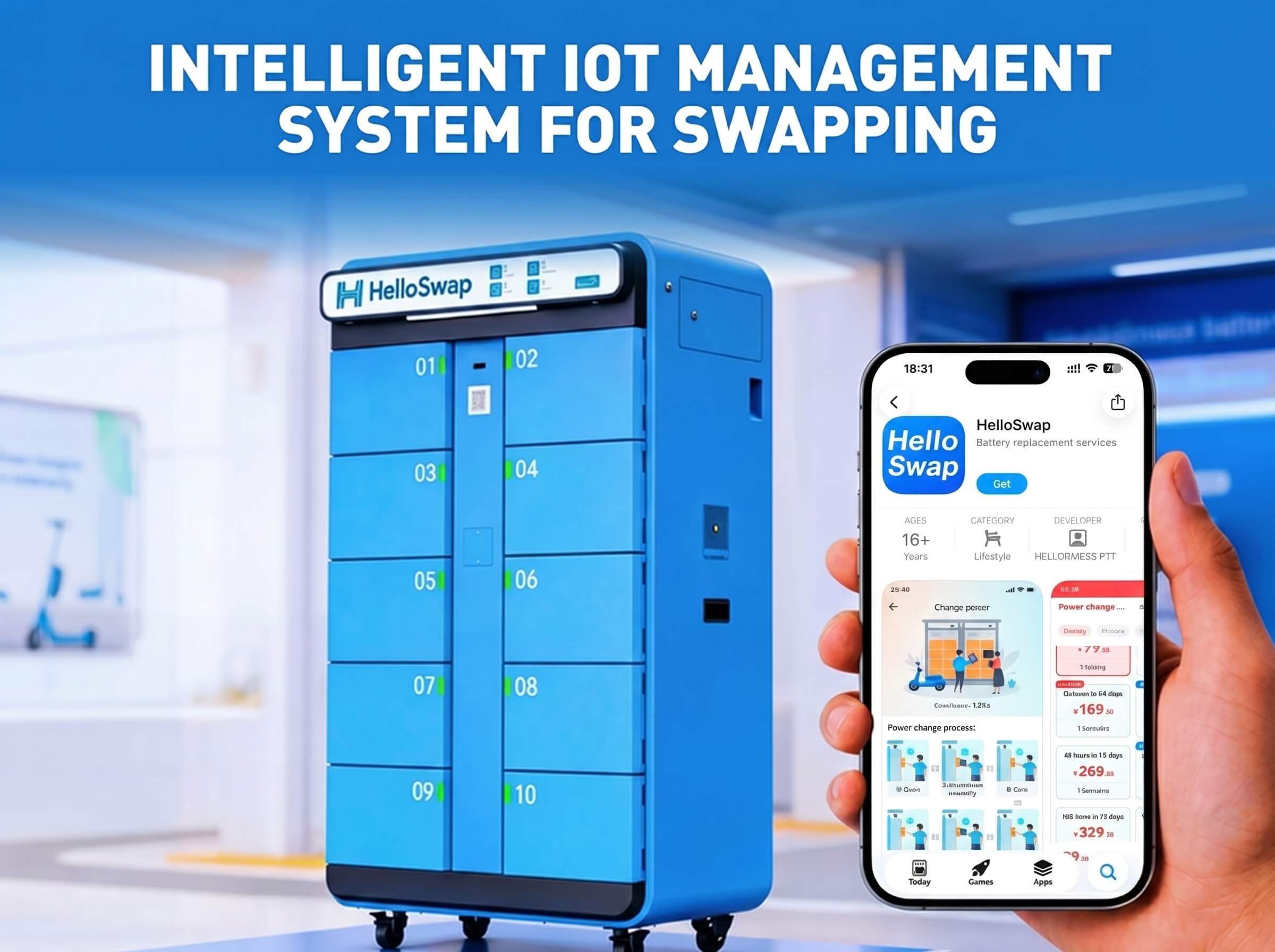
A connected battery swapping network typically operates across four layers, each targeting a different point where unmanaged operations tend to lose money or service reliability. Here is how each one works in practice.
Without continuous monitoring, battery degradation is invisible until it causes a problem. A properly implemented BMS tracks voltage, temperature, state of charge, state of health, and charge cycle history for every pack throughout its operational life. Charger authentication and identity verification ensure each battery is handled correctly, and the system rejects packs that fall outside defined electrical safety and compatibility standards before they enter the charging cycle. HelloSwap (also known as HelloPower) builds this rejection logic directly into every cabinet connection, so compliance documentation is generated through normal operations rather than assembled after the fact, and replacement scheduling moves from guesswork to evidence.
Cabinet downtime is a service failure, not just a hardware issue. In a connected network, each cabinet monitors its own slot conditions, logs swap events, and escalates anomalies to the management platform without waiting for a field technician. Safety and operational functions run locally at the cabinet level, so performance holds even when network connectivity is temporarily unstable. HelloSwap applies this local processing architecture across all cabinet models as standard, making deployment viable in markets where network infrastructure is still developing.
Data from batteries and cabinets is only useful when it reaches someone who can act on it. A cloud management platform consolidates inventory, station status, and demand patterns across all sites, so maintenance needs surface before they become service failures. The same platform projects remaining useful life for individual packs, enabling residual value assessment and second-life decisions such as stationary storage when a battery approaches the end of service. HelloSwap structures this through a SaaS layer for operational management and a PaaS layer for asset tracking, with API access that connects battery data directly into operators' existing logistics or fleet systems.
Swap demand is never evenly distributed, and static battery allocation across a network guarantees shortages in some locations and waste in others. A connected scheduling system tracks swap frequency and battery movement continuously, using accumulated operating history to balance charging priority, dispatch, and future station placement across the network. HelloSwap's scheduling logic compounds over time: the longer a network runs, the more precisely it reflects actual demand patterns at each location rather than assumptions made at deployment.
Fleet operators, infrastructure investors, and government partners each come to battery swapping with different priorities, but they draw on the same underlying platform.
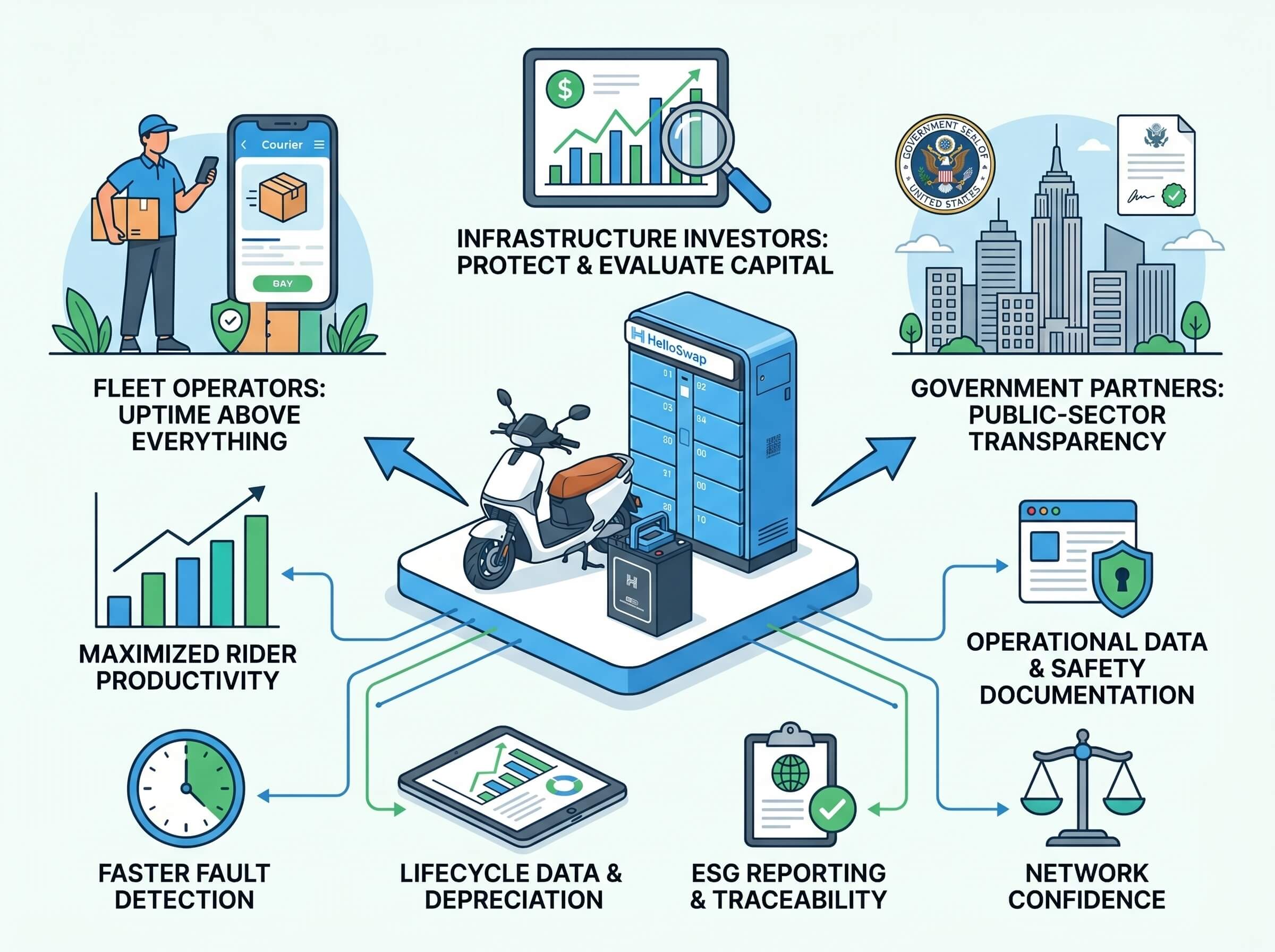
Fleet operators running food delivery, courier, or shared mobility services need uptime above everything else. Consistent swap availability, faster fault detection, and batteries that perform predictably across their service life reduce the interruptions that cut directly into rider productivity and fleet economics.
Infrastructure investors and project developers need to protect and evaluate deployed capital over time. Battery lifecycle data supports depreciation modelling grounded in actual usage rather than manufacturer estimates. Site-level utilization records make commercial performance measurable across locations. Because every swap and safety event is logged with a traceable digital record, compliance and ESG reporting becomes structured rather than improvised, a requirement that government-linked investors and international capital providers are enforcing with increasing consistency.
Government and concession partners bringing battery swap infrastructure into urban mobility or clean energy programmes need confidence that the network will hold up at scale and meet public-sector transparency standards. Operational data and safety documentation support those partnerships from procurement evaluation through the full term of a concession agreement.
The IoT layer of a battery swapping network is only as reliable as the operational experience behind it. Safety thresholds, scheduling logic, and lifecycle management parameters are not set once at launch. They are refined continuously through high-volume real-world deployment, and it takes years of that kind of operation to develop them to a point where they hold across different markets and conditions.
Co-founded by Hello Inc., Ant Group, and CATL, HelloSwap brings more than a decade of that experience to international markets, built across 500-plus cities with over 5 million batteries and 80,000 cabinets deployed. The parameters behind the platform reflect the edge cases, failure modes, and demand patterns that only emerge at scale. For partners evaluating battery swap infrastructure as a long-term commercial or policy commitment, that depth is worth weighing carefully alongside hardware specifications and upfront costs.
If you are building or scaling a battery swap network, contact the HelloSwap team to request a deployment assessment for your market.
Contact Us
hellopowerglobal@hellobike.com
Location
2F, Building 1, No.898 XiuWen Road, MinHang District, Shanghai, China
Copyright © 2024 福建宁德惠智无限科技有限公司 All Rights Reserved. 闽ICP备2023025900号-3.


