
How to Operate a Battery Swapping Business for Two-Wheeled EVs
2026-05-29
When people search for battery swapping in Africa, Spiro comes up almost immediately, and for good reason. The company has built the most visible electric motorcycle and battery swap operation on the continent, and its scale is difficult to ignore. For anyone trying to understand how battery swapping works in Africa, Spiro is the clearest reference point available. But for entrepreneurs, fleet operators, and investors looking to enter the battery swap market themselves, understanding Spiro's model also means understanding what it is not, and where other paths exist.

(Source: Spiro)
Spiro's growth is not simply a product story. It is a market entry model built around government-level coordination. In Kenya, the national government announced Spiro's plan to deploy 1.2 million electric vehicles. In Uganda, Spiro signed an MoU committing to 140,000 electric motorcycles and over 3,000 swap stations within five years. In Rwanda, Benin, Togo, and Nigeria, a similar pattern holds: national policy alignment, government-backed announcements, local assembly plants, and integrated financing structures that bundle the motorcycle, the battery, and the swap network into one package for riders.
This is precisely what makes Spiro capable of moving at the speed and scale it does. By securing national-level commitment before deploying, Spiro can justify the capital intensity of building hundreds of swap stations, assembling vehicles locally, and structuring rider financing, all at once, across an entire country. The company has secured more than $200 million in investment over the past three years to support this approach, and the results are real: 95,000 motorcycles operating across six countries, 2,500 swap stations, and over 30 million completed swaps.

(Source: Spiro)
What this model also means is that Spiro's expansion follows a specific sequence. A country comes into scope when the conditions align at a national level, with government willingness, policy backing, and the capital deployment that follows. Until those conditions are in place, the market waits.
Africa has 54 countries, and the demand for affordable, practical urban mobility is not waiting for any single operator's expansion timeline. In cities where Spiro does not yet operate, and even in countries where Spiro is present but has not reached full coverage, the need for battery swap infrastructure exists independent of any government program.
The operators who feel this most directly are not individual riders. They are the logistics companies managing delivery fleets, the motorcycle taxi cooperatives trying to cut fuel costs, and the entrepreneurs who see a viable business in providing reliable energy access to riders in their city. These operators do not necessarily need a national rollout. They need something they can start, test, and scale at a pace that matches their own capital and risk appetite.
That is the space where a battery swap equipment and platform supplier like HelloSwap becomes relevant.
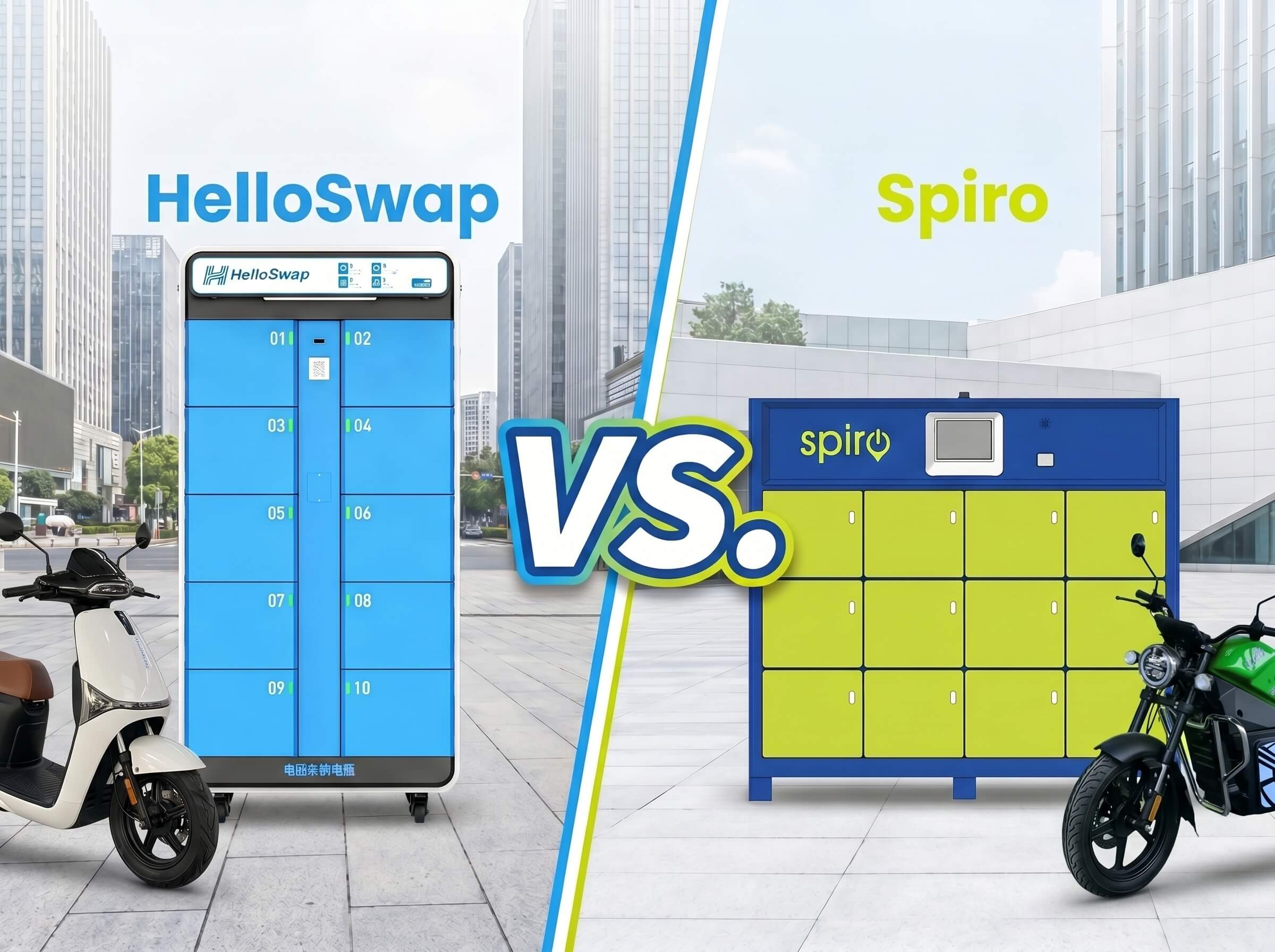
HelloSwap, also known as HelloPower, is backed by Hello Inc., CATL, and Ant Group, supplying the hardware and operating platform for battery swapping networks.
While Spiro's own partnership program is structured around distributing Spiro's vehicles and operating within Spiro's energy ecosystem, with defined investment thresholds and geography-specific exclusivity arrangements, a partner deploying HelloSwap is working from a different starting point: building a swap operation using HelloSwap's modular cabinets, battery management system, and cloud platform, at whatever scale makes sense for their specific market. That could mean a single operator serving a local delivery fleet in a mid-size city, or a regional entrepreneur building a network in a corridor that no integrated operator has yet prioritized.
Getting that network to run reliably is where the hardware matters. HelloSwap's swap cabinets are engineered to operate stably across -20°C to 55°C, with intelligent thermal management that maintains battery efficiency in high-heat, variable-grid conditions, a baseline requirement for any operator building infrastructure in tropical African markets. The platform has been validated across 500+ cities and 80,000+ deployed cabinets worldwide, giving African partners a proven technology foundation.
Company | Spiro | HelloSwap |
Model type | Integrated operator (vehicles + batteries + network) | Equipment and platform supplier |
Entry mechanism | Government-aligned, national-scale deployment | Partner-led, operator-owned deployment |
Partnership structure | Distributor or franchisee within Spiro's ecosystem | Franchise, white-label, or fleet integration |
Minimum viable scale | National program with policy backing | City-level or fleet-level pilot |
Current Africa presence | 6 countries, 95,000 motorcycles, 2,500 stations | Actively exploring partnerships with African operators |
Spiro's model works best when national-scale alignment is achievable. HelloSwap is built for operators who want to build on their own terms.
Spiro's continued expansion actually validates the case for independent operators in markets not yet reached. Every country Spiro enters confirms that the demand is real and the economics work. Every city where riders need affordable energy access but no integrated operator has arrived is a city where a well-equipped local partner can move first.
HelloSwap is actively exploring partnerships with African operators, fleet managers, and investors who want to build or scale battery swapping networks using proven global technology. From city-level pilots to multi-corridor deployments, the platform is designed to be deployed without a government agreement as a prerequisite, and the operational playbook behind it has been refined across hundreds of cities worldwide.

If you are planning an e-mobility or fleet electrification project in Africa, get in touch with the HelloSwap team now to explore what a deployment could look like for your market.
Contact Us
hellopowerglobal@hellobike.com
Location
2F, Building 1, No.898 XiuWen Road, MinHang District, Shanghai, China
Copyright © 2024 福建宁德惠智无限科技有限公司 All Rights Reserved. 闽ICP备2023025900号-3.


