
Investing in a Battery Swap Station for Two-Wheelers: What You Need to Know Before You Commit Capital
2026-05-14
Indonesia's EV transition keeps getting framed as a car story. The real opportunity is two wheels, and it is moving faster than most market analyses acknowledge.
Of the country's 139 million registered motorcycles, only around 236,000 are currently electric. That gap is an infrastructure problem. A food delivery rider in Bekasi or Surabaya cannot wait four hours for an electric motorcycle battery to charge, while conventional bikes refuel in two minutes. Until the energy replenishment gap closes, mass electric adoption among professional riders stays stuck.
Battery swapping closes that gap. Return a depleted pack, take a fully charged one, ride on in under a minute. It is the only energy model that actually fits how Indonesian two-wheeler riders work and earn, which is why it has become the dominant infrastructure approach for electric motorcycles in the country.
Indonesia holds 37.5% of the entire Southeast Asia battery swapping market. The electric two-wheeler segment was valued at USD 534 million in 2024 and is projected to grow to USD 1.61 billion by 2033 at a CAGR of around 11.7%.
That growth story hit a reset in 2025. When the government's IDR 7 million per-unit subsidy program wound down, electric motorcycle sales dropped by roughly half in the first half of the year. It clarified something important: Demand that only exists when subsidies are available is not really demand.
The policy environment is recovering on more durable terms. Indonesia's Finance Minister proposed in April 2026 a new incentive covering 100,000 electric motorcycles at approximately IDR 5 million per unit, with the program still under ministerial coordination as of publication. Battery-as-a-Service (BaaS) sits at the center of this recovery—when the battery cost is removed from the vehicle purchase price and converted into a subscription or per-swap fee, electric motorcycles become financially viable for professional riders regardless of whether a subsidy program is active. This is the model that survives policy cycles rather than depending on them.
Indonesia has a government target of 13 million electric motorcycles on the road by 2030 and official plans for 52,000 to 67,000 battery swap stations nationwide, against a current installed base of around 2,000. The infrastructure gap is large. So is the opportunity for operators positioned to close it.
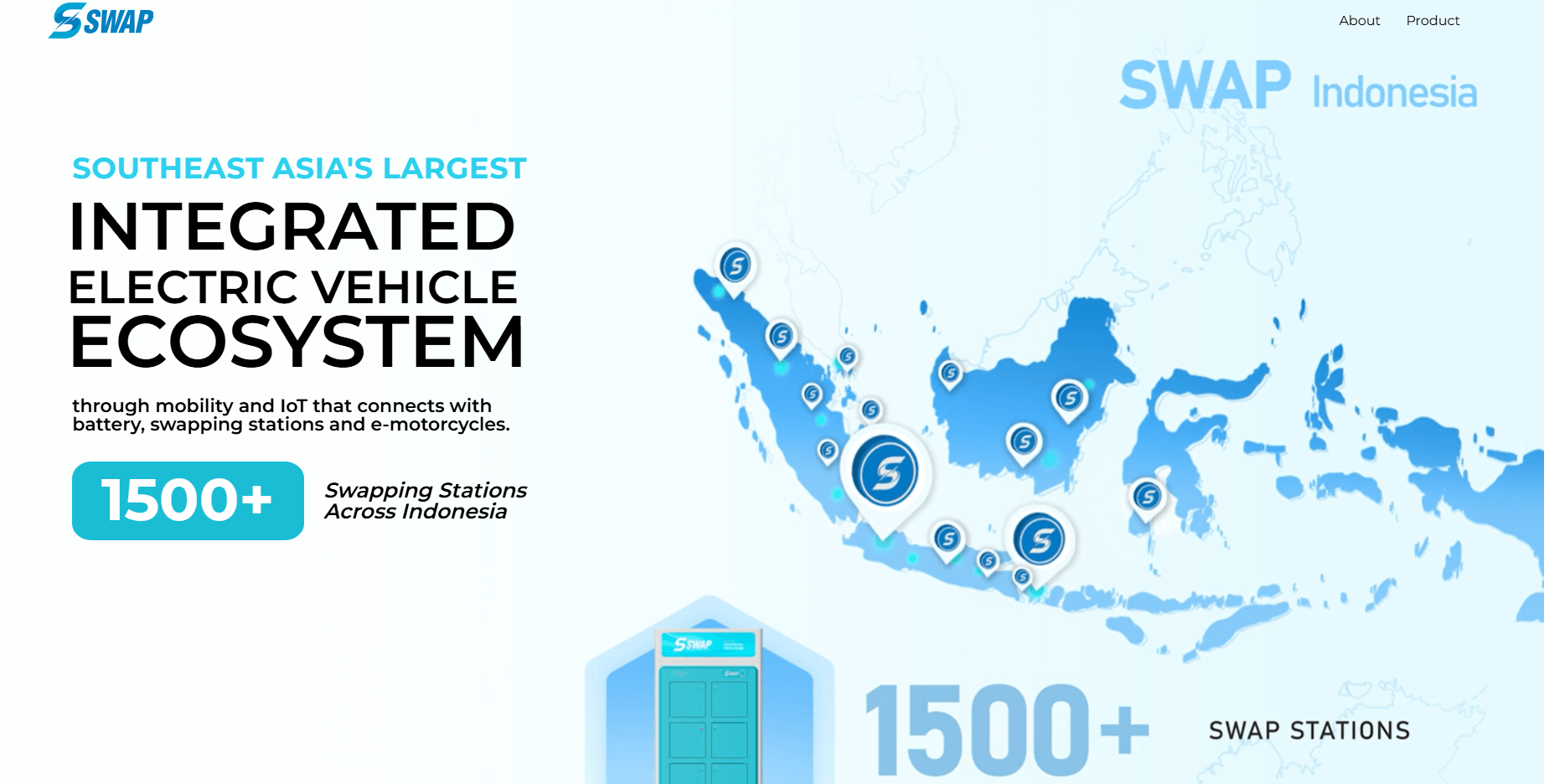
(Source: swap.id)
Founded in 2019, SWAP Energi is the largest battery swapping operator built natively for the Indonesian market. The company has deployed 1,500+ swap stations across Jakarta, Surabaya, Bali, and Bandung, concentrated at Circle K outlets, Alfamart stores, and high-traffic warungs along delivery corridors. Its app integrates with Google Maps for station discovery, and its battery format fits multiple popular motorcycle models.
What has made SWAP competitive is not just station count. It is the fleet side of the business. SWAP holds fleet partnerships with Grab and Lazada, anchoring a portion of its utilization with contracted riders before a station is switched on—a playbook that's right for this market.
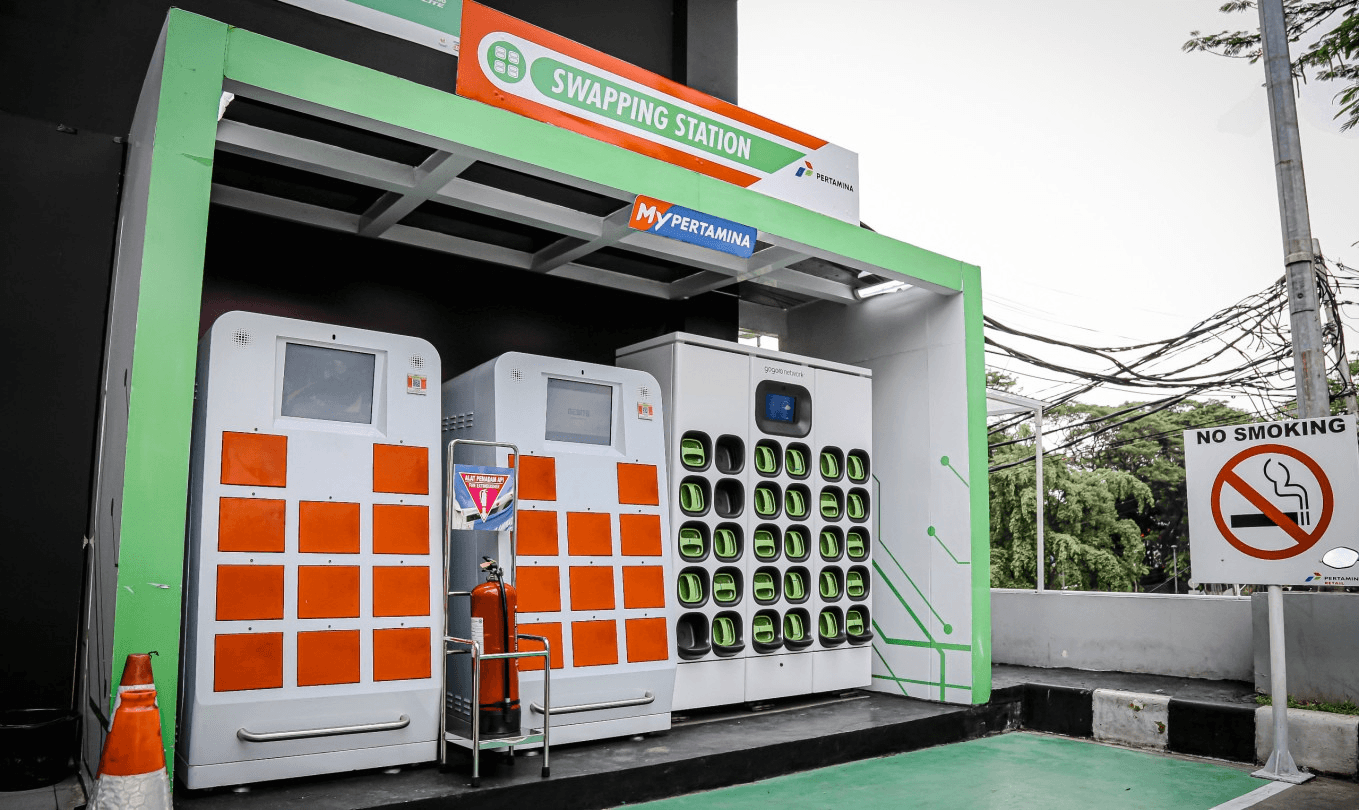
(Source: Pertamina Patra Niaga)
State oil subsidiary Pertamina Patra Niaga entered battery swapping by deploying stations at its SPBU COCO petrol station network, operating 46 battery swap units across greater Jakarta by early 2024, with 25 of which opened to the general public. Converting fuel stations into energy hubs for electric motorcycles as ICE demand declines is a logical hedge—one backed by national distribution reach that no private operator can replicate independently.
When a state-owned energy company commits to swap infrastructure, it reflects government confidence in the model's long-term viability.
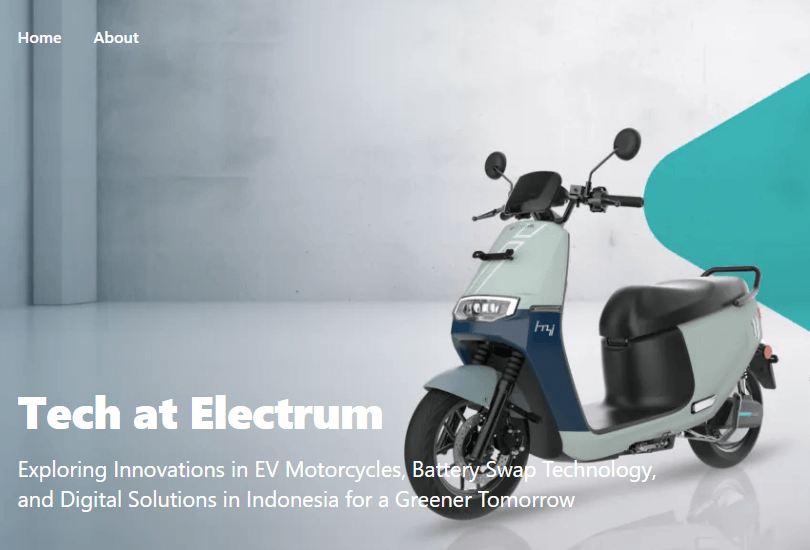
(Source: electrum.id)
Electrum is the joint venture between Gojek's parent GoTo Group and TBS Energi Utama, using Gogoro's battery swapping platform as its technology foundation. By 2025, Electrum had deployed over 370 swap stations supporting more than 6,000 electric motorcycles across Jabodetabek, and expanded its locally manufactured lineup from the H3 series to the higher-performance H1—all TKDN-certified and eligible for the government's electric motorcycle incentive program.
Electrum's deeper advantage is on the demand side. Gojek's driver network in Indonesia numbers in the hundreds of thousands. Having that as a captive fleet anchor changes the economics of swap network expansion in a way that few new entrants can replicate.
(Source: Astra Honda)
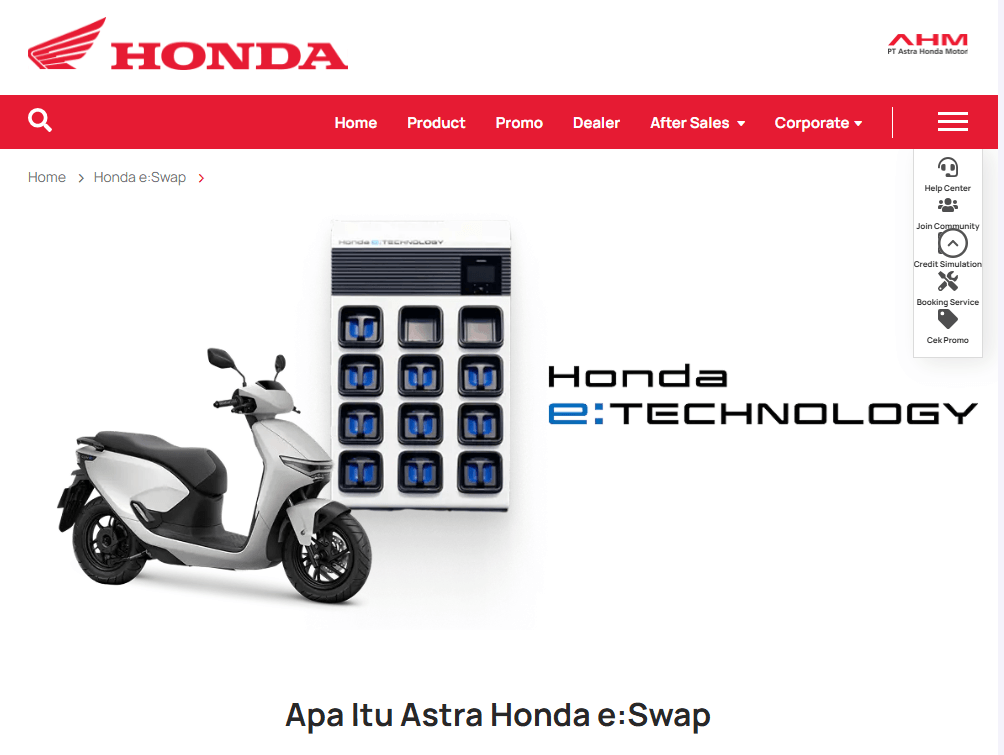
Astra Honda Motor launched its battery sharing service in Indonesia in early 2025, using the EM1e and CUV e: models built on Honda's Mobile Power Pack platform. The CUV e: has established itself as the benchmark in Jakarta's urban commuter and business rental segment, combining OEM-level vehicle-energy integration with a national dealer and service network.
When Indonesia's leading motorcycle brand commits to battery swapping over fast-charging as its primary electric energy model, the technology debate for two-wheelers is effectively settled.
(Source: NFCX)
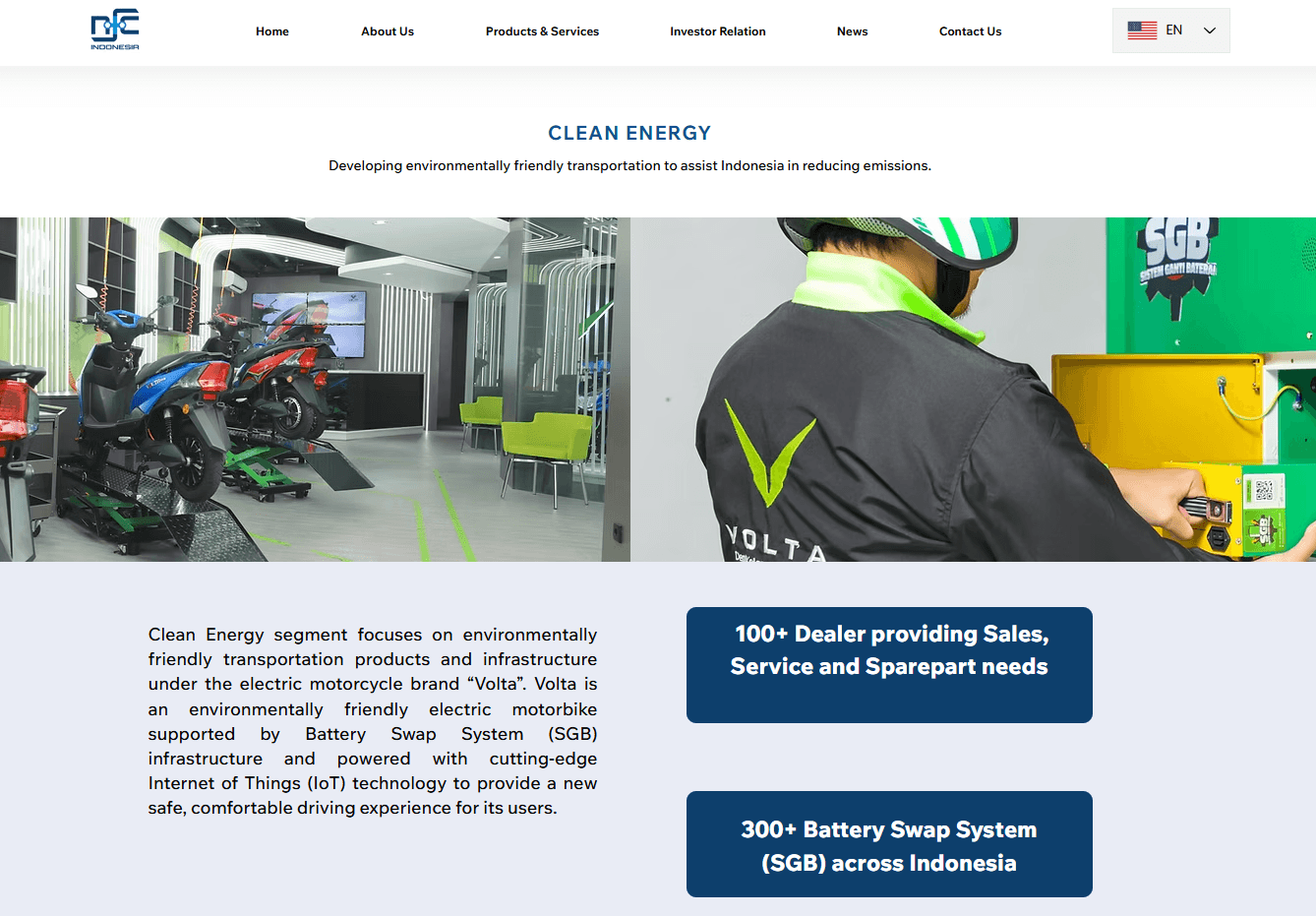
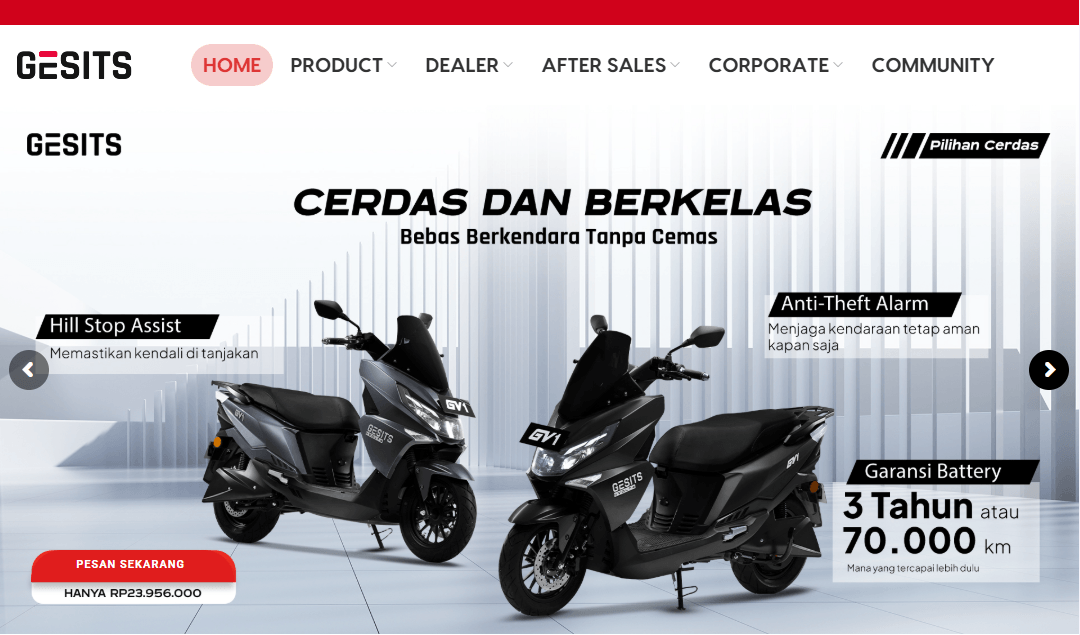
NFCX (PT NFC Indonesia Tbk) has been active since 2013, developing end-to-end electric mobility systems, including its own EV manufacturing and swap station hardware. GESITS is Indonesia's homegrown electric motorcycle brand, embedded in government-supported electrification programs since the late 2010s. Both represent the locally rooted layer of the market—an important context for any international operator navigating local partnership expectations and regulatory dynamics.
(Source: Gesits Motor Nusantara)
Indonesia has about 2,000 swap stations today against a government target of 52,000 to 67,000. The gap is not primarily a capital problem. It is an operations problem.
Three things consistently challenge operators who underestimate what it takes to run a swap network in Indonesia:
Thermal stress on hardware. Jakarta's climate averages 70 to 90% relative humidity year-round, with temperatures regularly reaching 31°C and above. Most swap cabinets designed for temperate markets degrade faster here than lab specifications suggest. Battery cell wear, cabinet component failure, and connector corrosion all accelerate in sustained tropical heat and moisture.
Uptime across mixed deployment locations. A cabinet inside an air-conditioned Circle K and one mounted on an open roadside in Surabaya face completely different operating conditions. Hardware not specifically rated for outdoor tropical deployment generates maintenance overhead that quickly erodes station economics.
Fleet rebalancing without a large ground team. At network scale, knowing which stations are running low at 6 am before riders notice, which batteries are degrading before they fail, and how to redistribute inventory across a city in real time requires a data and operations layer that most hardware-first deployments do not include.
Operators who have approached Indonesia as a procurement exercise have found that the operational complexity far exceeds the hardware cost. The swap networks that are growing are the ones treating real-time battery management and predictive station operations as core infrastructure, not optional add-ons.
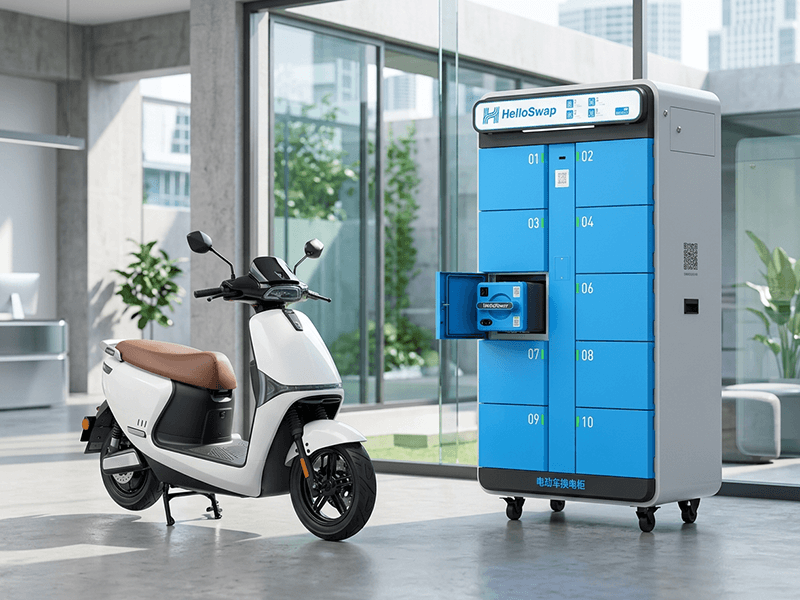
HelloPower (HelloSwap), backed by Hello Inc., CATL, and Ant Group, currently operates across 500+ cities with 80,000+ deployed smart swap cabinets and over 800 million platform users.
On the hardware side, HelloPower's cabinets are IP54-rated for tropical rain and humidity, with integrated per-slot fire suppression, dual mechanical locks, and 24/7 cloud monitoring. Batteries achieve over 2,000-cycle lifespans across a -20°C to 65°C operating range. For operators who need a complete fleet solution, HelloPower also supplies compatible electric motorcycles purpose-built for the swap ecosystem. On the software side, a SaaS+PaaS platform delivers real-time network visibility, predictive maintenance, and intelligent battery dispatching without requiring additional headcount.
HelloPower's solution is built as an export and partnership platform. Complete hardware and software systems are deployed by local operators with full operational support from a team that has already processed hundreds of millions of swap cycles. There is no local manufacturing requirement on the operator side. The system arrives ready to run.
Whether you are a fleet operator looking to electrify a delivery team, a logistics investor evaluating battery swapping infrastructure, or an entrepreneur assessing the station operator business model, the entry window in Indonesia is open now.
Fill out the contact form below or visit our contact page to discuss deployment models, fleet partnerships, and market entry support.
Contact Us
hellopowerglobal@hellobike.com
Location
2F, Building 1, No.898 XiuWen Road, MinHang District, Shanghai, China
Copyright © 2024 福建宁德惠智无限科技有限公司 All Rights Reserved. 闽ICP备2023025900号-3.


