
Battery Swapping for Electric Two-Wheeler Market: What the Global Numbers Actually Mean for You
2026-05-08
Every battery swapping startup faces the same fork in the road: build everything yourself, or partner with an established network to reach scale faster. The instinct to own the full stack—batteries, cabinets, software, network—feels like control. In practice, it is often the fastest path to burning through your runway before your first thousand users arrive.
Indeed, the binary of "build vs. compete" is a false choice. The most successful operators in the two-wheel and three-wheel EV space have learned something counterintuitive: Your fastest route to growth is often through a partner who has already solved the hard infrastructure problems.
Building a proprietary battery swap network from scratch requires far more than most founders anticipate. Full-scale urban infrastructure, covering station hardware, grid connection, real estate, and ongoing operations, can run well into six or seven figures per site. Even modular micro-cabinets designed for two-wheeler deployments carry a meaningful upfront cost when multiplied by the 50 to 100 locations needed for viable citywide coverage.
This is what practitioners call the "Capital Valley of Death" for battery swapping startups—the gap between a promising pilot and a self-sustaining network. Most companies that fail do not fail because of bad technology. They run out of money trying to own infrastructure that already exists elsewhere.
The smarter framing: Your competitive advantage is not the cabinet. It is your customer relationships, fleet management software, local market knowledge, or pricing model. The physical infrastructure is a means to an end, and it does not need to be yours.
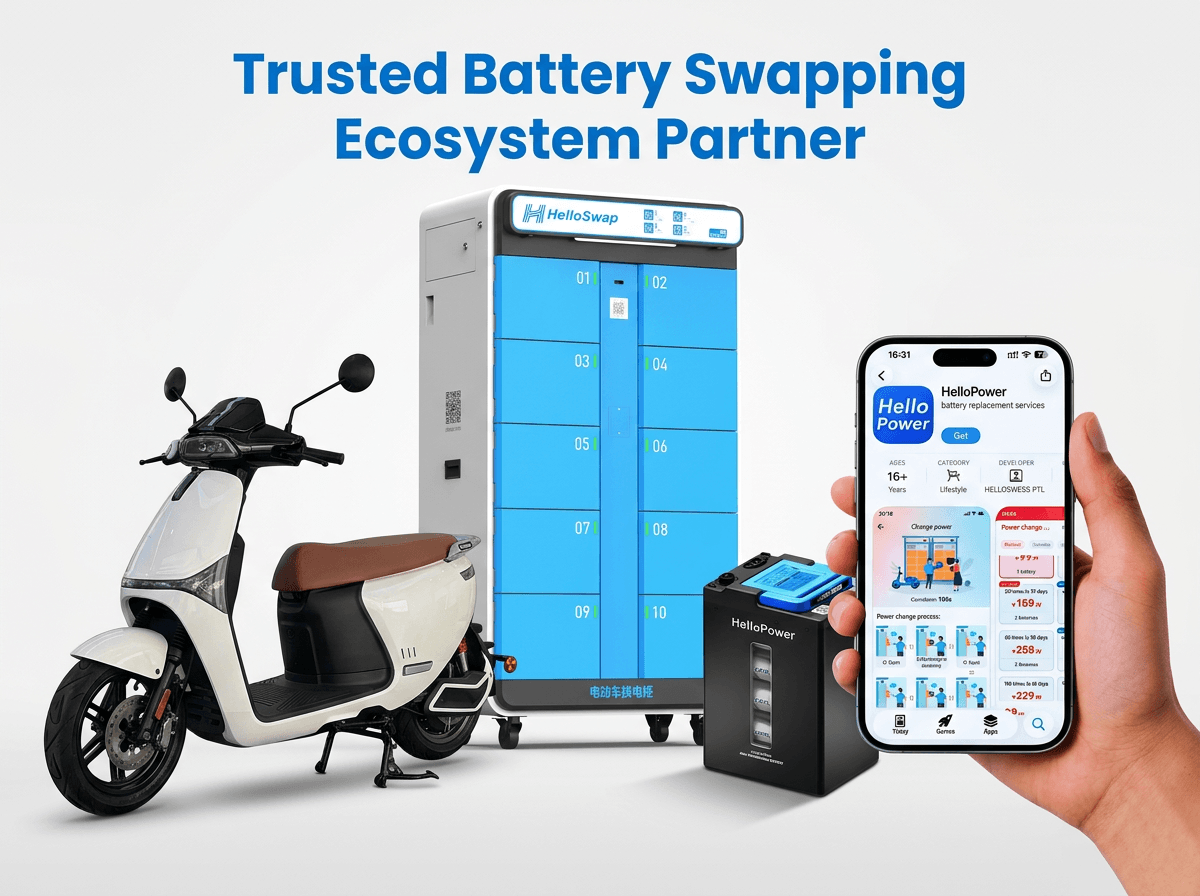
Rather than deploying your own stations, startups can plug into an established swapping grid under a white-label or revenue-sharing arrangement. Your brand, your app, your customer—but the physical backbone belongs to a partner with proven hardware and 24/7 operational support. This model compresses your time to market from years to months.
The advantage extends beyond cost. An established operator has already solved the unglamorous problems—cabinet fire suppression systems, weatherproofing for outdoor deployment, real-time battery health monitoring, and the logistics of battery rotation across dozens of sites simultaneously. You inherit that reliability on day one.
Some startups want to operate their own stations but do not need to manufacture or own battery assets outright. Under a BaaS model, you lease standardized batteries from a supplier and pass that cost to riders on a per-swap or subscription basis, converting a large capital expense into a predictable operating cost. Investors and fleet operators both prefer this structure.
BaaS only works when the underlying battery quality holds up in real fleet conditions. A battery that degrades unpredictably, fails in heat or cold, or lacks remote diagnostics becomes a liability you cannot manage at scale. What matters operationally is whether a battery can sustain reliable performance throughout the full commercial lifecycle, consistently delivering the range your riders depend on, day after day, without unexpected downtime. The battery is what your customer touches every single day; its field performance is your brand reputation.
Not every partnership requires formal contracts. Two companies that technically compete can avoid destructive overlap by focusing on different customer segments or regions. One operator serves food delivery fleets in a capital city; another focuses on shared e-bike programs in secondary towns. One handles B2B fleet accounts; another targets individual consumers on subscription plans.
This model is especially relevant in high-growth Southeast Asian markets, where the total addressable market is large enough that early operators benefit more from growing the overall category than from fighting over a small existing base. Collaboration on station siting, battery standard adoption, and regulatory advocacy creates value that neither party could generate independently.
Most startup-to-operator partnerships fail not because of strategic disagreement, but because of three operational friction points that were never resolved upfront.
Battery format lock-in is the most common dealbreaker. If your vehicles require a proprietary connector, communication protocol, or physical dimension that no one else uses, you have built a wall that keeps partners out. Startups that design around widely adopted voltage platforms maintain long-term optionality. For the electric two- or three-wheeler market, compatibility across 48V, 60V, and 72V powertrains is the practical baseline—it covers everything from entry-level delivery scooters to high-performance cargo three-wheelers. A platform-agnostic approach to vehicle OEM integration, where different brands can handshake with your swapping system via open BMS communication, is increasingly what fleet buyers expect in 2026.
Data ownership ambiguity is the second friction point. Battery usage data, rider behavior patterns, and station utilization metrics all carry real commercial value. Who owns it, who can monetize it, and how it is shared across parties needs to be defined contractually before the first swap, not after a dispute arises.
Unit economics misalignment closes the list. If both parties are not clear on who receives what revenue per swap, who bears maintenance costs, and how pricing adjusts as utilization scales, the relationship will break down precisely when the business starts growing. Scaling is where the math gets real, and partnerships that looked fine on paper at 200 swaps per day can collapse at 2,000.
One more element worth flagging is the payment infrastructure. Startups frequently underestimate the friction of building their own payment and credit systems for BaaS subscriptions. A swapping partner with integrated fintech infrastructure—enabling pay-as-you-go models, credit-based access, and seamless rider onboarding—removes an entire layer of product development that most hardware-focused startups are not well-equipped to build.
Before committing to any partnership model, run through this checklist:
Voltage compatibility: Does your powertrain support 48V, 60V, or 72V platforms?
BMS communication: Is your battery management protocol open to third-party handshake (CAN or 485)?
Physical dimensions: Does your battery bay accommodate the 2kWh to 5kWh form factors common across swapping ecosystems?
Operational climate: Is your hardware rated for the temperature and humidity range of your target market?
Data agreement: Have you defined data ownership terms with any potential infrastructure partner?
If you can check all five, you are in a strong position to negotiate a partnership rather than starting from scratch.
Operators who scale successfully tend to follow a consistent pattern: Partner early to establish coverage and credibility, then differentiate later through software, fleet services, financing products, or geographic depth that partners cannot easily replicate.
HelloPower, operating as HelloSwap in some markets, is a reference point for what mature swapping infrastructure looks like at scale. The network spans 500+ cities, with 80,000+ intelligent swap cabinets deployed and 5 million+ batteries in active circulation, serving over 800 million registered users globally. The infrastructure is backed by CATL for battery supply and Ant Group for fintech integration—meaning payment flows, credit access, and rider onboarding are handled at the platform level rather than rebuilt by each individual operator.
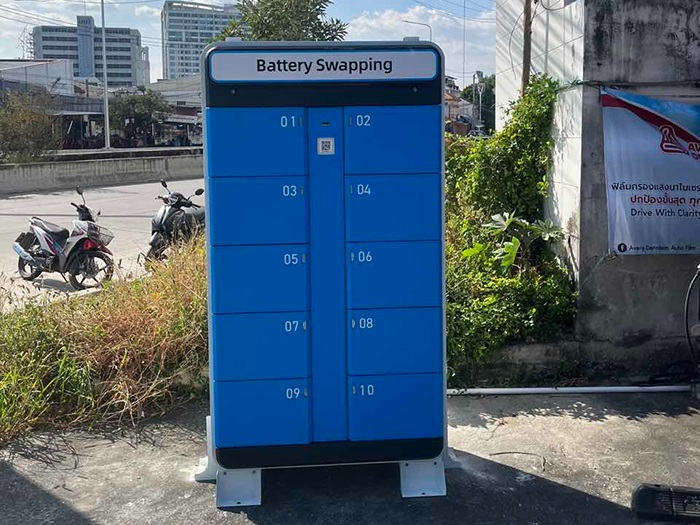
In Thailand, for example, HelloSwap has localized cabinet hardware for tropical operating conditions, a critical detail in a market where heat and humidity are among the primary causes of battery degradation. Thailand is also the fastest-growing EV two-wheeler market in Southeast Asia in 2026, with government subsidies accelerating fleet electrification across delivery, logistics, and shared mobility. For a startup entering this market, that existing infrastructure layer removes years of groundwork that would otherwise consume early capital.
Three questions clarify which partnership approach fits your model:
Do you control the customer or the infrastructure? If your edge is customer acquisition and fleet relationships, partnering for hardware infrastructure is rational. If your edge is hardware and manufacturing, operating your own network may make sense over time.
What is your time horizon for unit economics? White-label and BaaS models reach positive unit economics faster but with lower ceiling margins. Owning infrastructure takes longer to pay off but builds a more defensible long-term position.
Which battery standards are winning in your target market? Standardization is accelerating across high-growth markets. Designing around a proprietary format that does not reach critical mass is a company-ending risk. Align with the direction the market is already moving.
Battery swapping infrastructure is closer to telecom networks than to typical hardware markets, as the network effects of a shared grid make cooperation structurally more valuable than fragmentation. Battery swapping startups that understand this early, recognizing that they do not need to own every layer of the stack to win their segment, consistently out-execute those that try to build everything themselves.
The capital saved on infrastructure becomes the capital that funds sales, localization, software development, and the customer experience improvements that actually drive retention and long-term differentiation.
If you are building in the electric two- or three-wheel EV battery swapping space and want to explore what a partnership could look like for your market—white-label infrastructure, BaaS battery supply, or a co-deployment arrangement—HelloPower is open to that conversation. You can scroll down to fill out the contact form or visit our Business Cooperation page.
Contact Us
hellopowerglobal@hellobike.com
Location
2F, Building 1, No.898 XiuWen Road, MinHang District, Shanghai, China
Copyright © 2024 福建宁德惠智无限科技有限公司 All Rights Reserved. 闽ICP备2023025900号-3.


