
How to Operate a Battery Swapping Business for Two-Wheeled EVs
2026-05-29
Malaysia has 13.6 million registered two-wheelers on the road. As of the end of 2023, that made it the 13th largest motorcycle market in the world, and one where electric two-wheeler sales grew 61.6% in 2025 despite still being a small fraction of total registrations. The absolute numbers are modest. The direction is not.
For operators, fleet managers, logistics companies, and investors looking at the battery swapping space, Malaysia in 2026 sits in an unusual position: the market direction is clear, but the competitive lanes aren't yet filled.
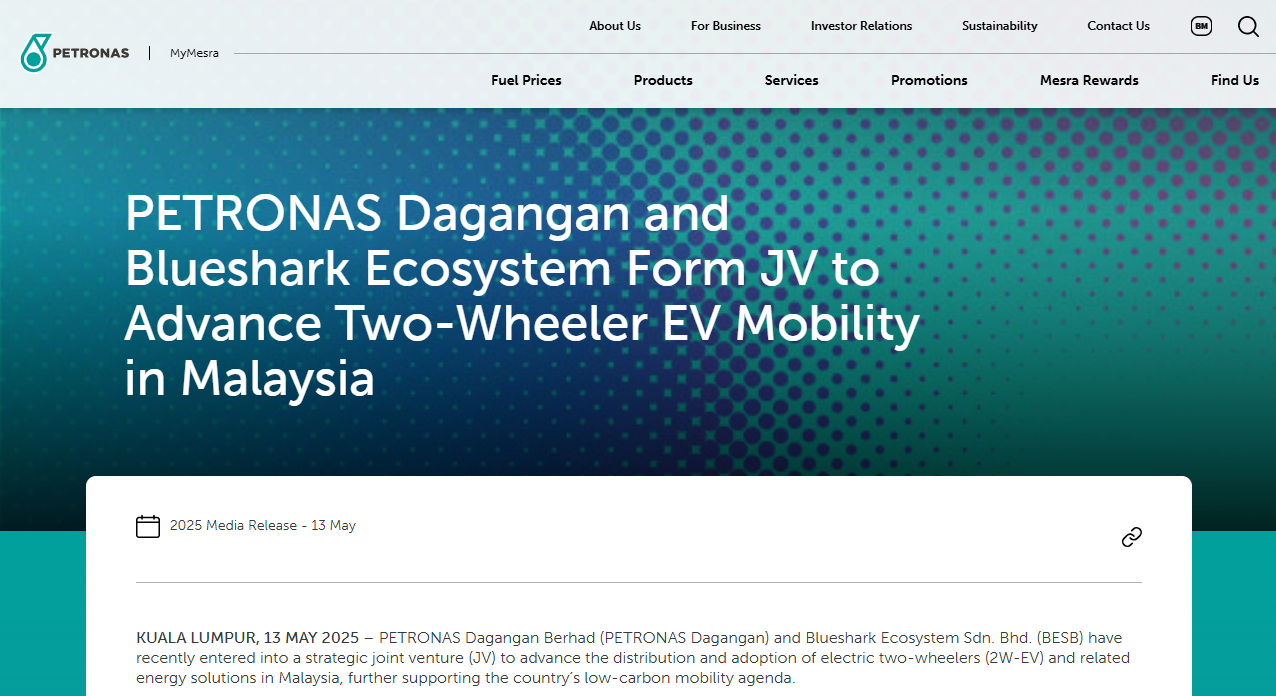
(Source: PETRONAS)
The most visible proof point is the Blueshark and Petronas Dagangan joint venture, formalised in May 2025 with Blueshark Ecosystem holding a 51% stake. The partnership set a target of more than 50 BlueStation locations nationwide by mid-2026, up from around 20 at the time of the announcement. The infrastructure, though, is concentrated almost entirely in the electric scooter segment.

(Source: Blueshark)
Blueshark's rollout has followed commuter density and existing fuel station footprint: Petaling Jaya, Shah Alam, Cheras, Bangsar, and eventually Penang Island. That logic makes sense for a scooter brand building infrastructure for its own vehicle owners. What it does not produce is open, interoperable swap access for a mixed fleet of different brands and operators.

(Source: Oyika)
Oyika and RydeEV operate as a combined platform, with Oyika supplying the swap technology and cabinets and RydeEV handling e-motorcycle leasing, deploying stations at convenience stores and shopping malls across the Klang Valley. RydeEV also participated alongside Blueshark in the MGTC and UNIDO government pilot programs. The result is a market with several operators, each working within their own segment, and the question for anyone entering now is which of those gaps is worth building into.

(Source: Malaysian Green Technology and Climate Change Corporation, MGTC)
The case for battery swapping in Malaysia's delivery sector isn't theoretical. GrabFood, Foodpanda, and ShopeeFood operate at real scale in KL, Penang, and Johor Bahru, and their riders have no tolerance for multi-hour charging waits mid-shift when income depends on completed orders. MGTC's pilot programs with commercial riders demonstrated measurable emission reductions and operational cost savings against petrol. The economics are straightforward once swap access is reliable: less downtime per shift, more orders completed, lower per-km energy cost.
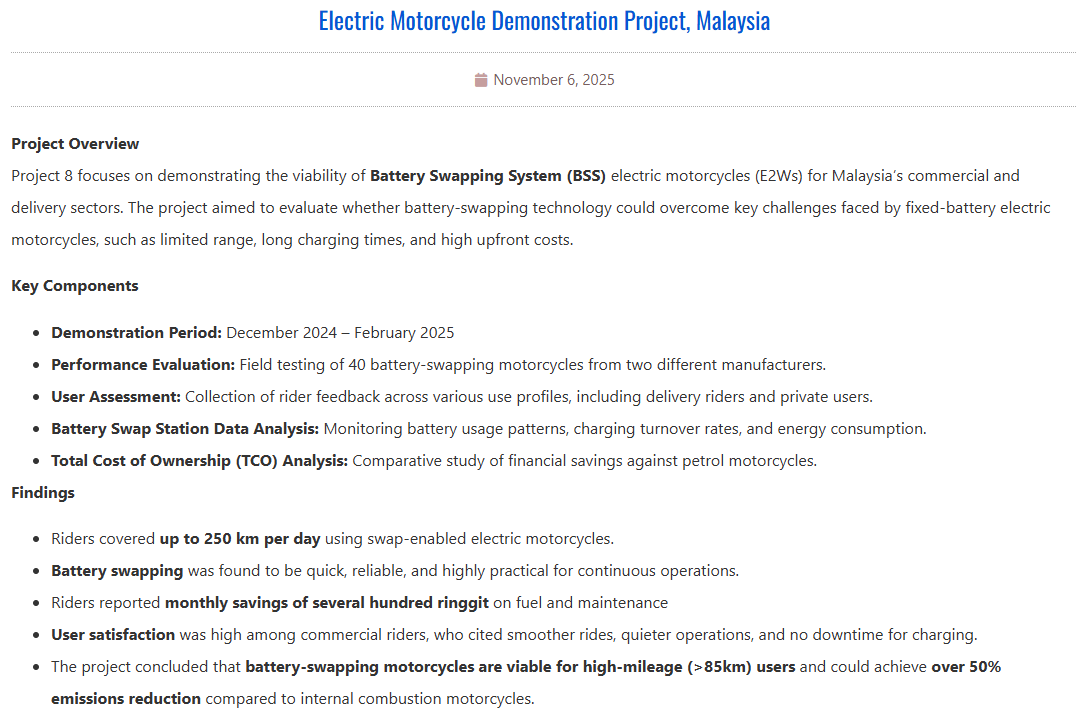
(Source: MGTC)
The friction isn't the value proposition. It's the network density required to make the swap option feel dependable rather than stressful. A single swap station per neighbourhood doesn't work for a rider who needs to swap two or three times a day. The math on placement is unforgiving, because you need enough coverage within a rider's working radius that they're never more than a few minutes from a functional cabinet with a charged battery actually available.
This is why operators gaining traction in comparable markets—HelloSwap (HelloPower)'s deployments across 500+ cities and expanding presence in Southeast Asia follow the same logic—consistently start with anchor fleet agreements rather than waiting for organic user growth to justify station density. A fleet partnership removes the utilisation uncertainty before you build. Without one, you're betting that enough individual riders discover your stations quickly enough to cover operating costs. That tends to be a long wait.
Malaysia's National Low Carbon Mobility Blueprint targets 15% electric motorcycles on the road by 2030. MGTC has run demonstration pilots, co-funded infrastructure trials, and worked with UNIDO to validate commercial swap models. That is a genuine policy tailwind.

(Source: Malaysian Investment Development Authority, MIDA)
The caveat is that "directionally supportive" and "operationally clear" are not the same thing. Battery standardisation—a common physical format and communication protocol that works across different EV brands and swap operators—has not been resolved. Today, Blueshark batteries work in Blueshark scooters. Oyika's system works with Oyika-compatible vehicles. There is no shared standard.
This matters depending on your business model. A vertically integrated operator who sources the vehicle, owns the battery, and runs the cabinet can work around the current fragmentation. An operator trying to run a swap network for an open fleet of mixed-brand electric motorcycles hits it as a fundamental design constraint from day one. The government has signalled standardisation as a priority, and electric two-wheeler sales growing 61.6% in 2025 are increasing the pressure to act on it. Operators entering now need to plan for the current reality, not the anticipated one.
The operators who have struggled in this region share a pattern: the hardware worked, but the network didn't. The gap is almost always operational.
Placement is the first place this shows up. A station in Kota Damansara serves a different rider population than one in Cheras or Wangsa Maju, and a network built on geographic spread rather than delivery-order density ends up with stations that are technically available but practically out of reach for the riders who need them most.
Battery condition is the second. When a rider swaps a depleted battery and the replacement turns out to be nearly as degraded, that is not a technical glitch, but a trust failure, and one bad swap can undo weeks of habit formation. Diagnostics, rotation protocols, and real-time cabinet monitoring are what keep that from happening at scale.
Pricing is the third, and the one most often underestimated. A subscription model that works for a salaried commuter doesn't necessarily work for a gig-economy rider whose income varies week to week. The operators who get retention right usually start by understanding the actual income patterns of their target riders, and they typically learn the consequences of skipping that step the hard way.
Building a swap network in Malaysia from scratch means solving the placement problem, the battery health problem, and the pricing problem simultaneously, without the operational data to know if your answers are right until riders start churning.
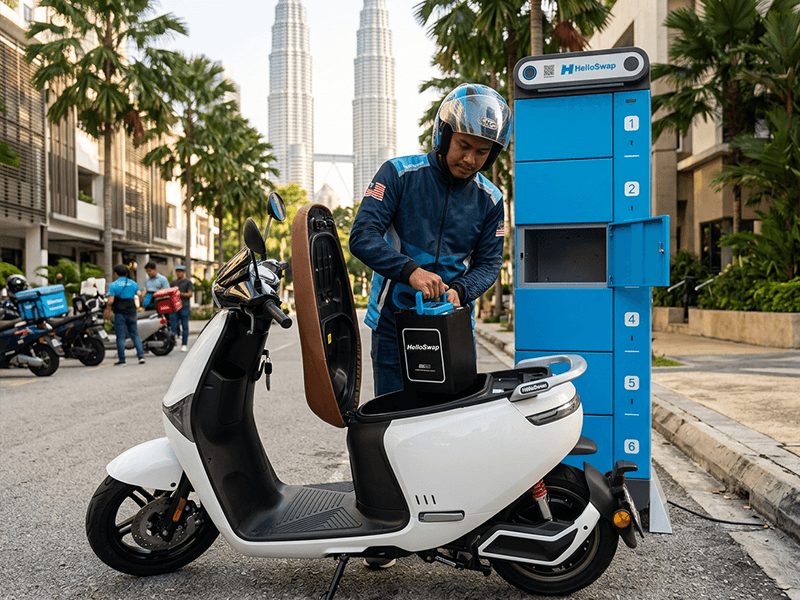
HelloSwap's offer to Malaysian operators and fleet managers is a shorter path through that. The backing from Hello Inc., Ant Group, and CATL means the battery technology, payment infrastructure, and operations software come tested rather than built. More than 80,000 cabinets in the field and over 5 million batteries in circulation mean the deployment playbook exists, including the Bangkok rollout as the closest regional reference point.
For a fleet operator deciding between plug-in charging and swap infrastructure, the core question is predictable uptime at scale. For an entrepreneur or investor evaluating an operator play, it's how to compress a multi-year learning curve. Those are the conversations worth having now, before the market's longer-term structure becomes harder to enter.
Exploring battery swap deployment in Malaysia? Reach out to the HelloSwap team. HelloSwap works with partners across Southeast Asia and can speak to what actual deployments take.
Contact Us
hellopowerglobal@hellobike.com
Location
2F, Building 1, No.898 XiuWen Road, MinHang District, Shanghai, China
Copyright © 2024 福建宁德惠智无限科技有限公司 All Rights Reserved. 闽ICP备2023025900号-3.


