
Investing in a Battery Swap Station for Two-Wheelers: What You Need to Know Before You Commit Capital
2026-05-14
At HelloSwap, we don't have to speculate about this question. We operate battery swap networks across 500+ cities, with 80,000+ swap cabinets, 5 million batteries in active circulation, and more than 10 million vehicles on the road. The answer we see every day is yes, though the more useful question is what's actually making it happen, and why the conditions in 2026 look different from five years ago.
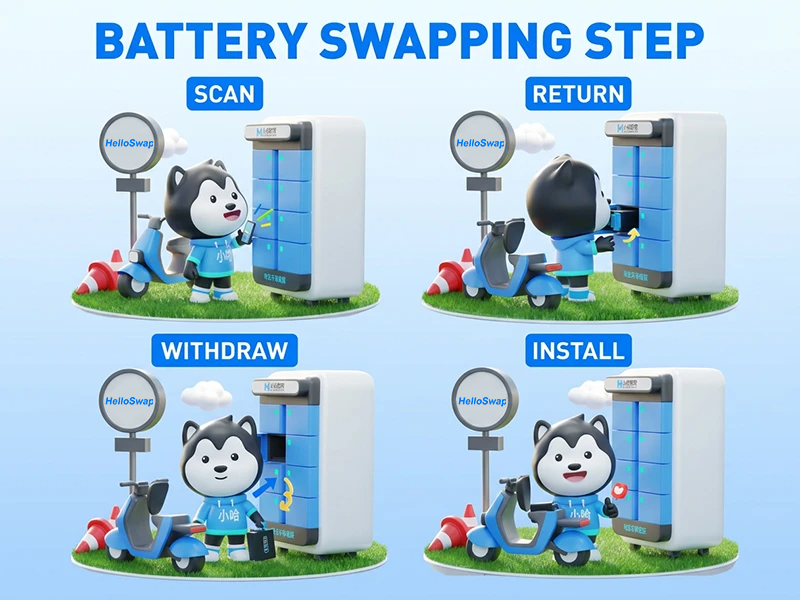
Battery swapping for two-wheelers is not a complicated process. A rider scans a QR code, returns a depleted battery, picks up a fully charged one, and leaves. Under a minute. The hardware to make that work has existed for years.
What took longer was everything around the technology: enough stations in enough places that riders would trust the network, vehicle designs built around swappable battery formats, and some level of standardization so a cabinet could serve more than one brand. These are coordination problems, not engineering problems, and they take longer to solve because they require multiple parties to move together.
That coordination is now happening, across multiple markets, at the same time.
A battery swap network with sparse coverage is a proof of concept. A network dense enough that a rider can find a battery swapping cabinet within a few minutes, anywhere in a city, is infrastructure. The two are fundamentally different paradigms, even if the underlying technology is identical.
China has reached that second version. The country's two-wheeler battery swap network is now one of the densest in the world, with major operators—including HelloSwap—running tens of thousands of cabinets across hundreds of cities. The scale is no longer a projection; it's an operational reality that other markets are actively studying.
Other markets are following quickly. V-Green, VinFast's energy subsidiary, has deployed 4,500 battery swap stations across Vietnam with a nationwide target of up to 60,000 swap cabinets. Indonesia has set a national government target of tens of thousands of swap stations to support its electric motorcycle transition by 2030. Across these markets, battery swap infrastructure is no longer a pilot—it's being built as permanent, city-scale infrastructure.
One of the legitimate criticisms of battery swapping has been fragmentation. Too many battery formats, too little interoperability, too much risk that building a network today means building a proprietary island.
That criticism is losing ground, though it hasn't disappeared entirely.
The European Stan4SWAP project, backed by CEN/CENELEC, concluded in late 2025 by publishing a standardization roadmap for swappable battery systems for light electric vehicles and formally handing it off to CEN/TC 301 Working Group 19 for binding standard development. That handoff matters, as it moves battery swapping standardization from research into the official European standards pipeline. A completed standard is still ahead, but the groundwork is now in place—and for operators evaluating cross-border network deployment, that changes the risk calculation.
In India, the Bureau of Indian Standards is actively developing battery swapping standards focused on interoperability, specifically the ability for a battery from one manufacturer to function in a vehicle from another. The direction is clear, and it aligns with India's broader EV infrastructure ambitions for the decade.
Progress on standardization rarely makes headlines. But for anyone evaluating whether to build swap infrastructure, the question of "will there be a common standard?" is shifting from "we don't know" toward "yes, and here's the timeline."
The battery swap cabinets being deployed today look similar to what existed five years ago. What's changed is what's running inside them.
Every slot is monitored continuously: temperature, voltage, state of charge, cycle history. Batteries that show abnormal patterns are flagged before they re-enter circulation—a process driven by the intelligent BMS embedded in each pack. Demand forecasting at the cabinet level means that high-traffic locations have charged inventory ready when riders need it, not just when the overnight charging cycle happens to finish. Fleet operators get visibility into battery health across their entire vehicle base, not just the one bike in front of them.
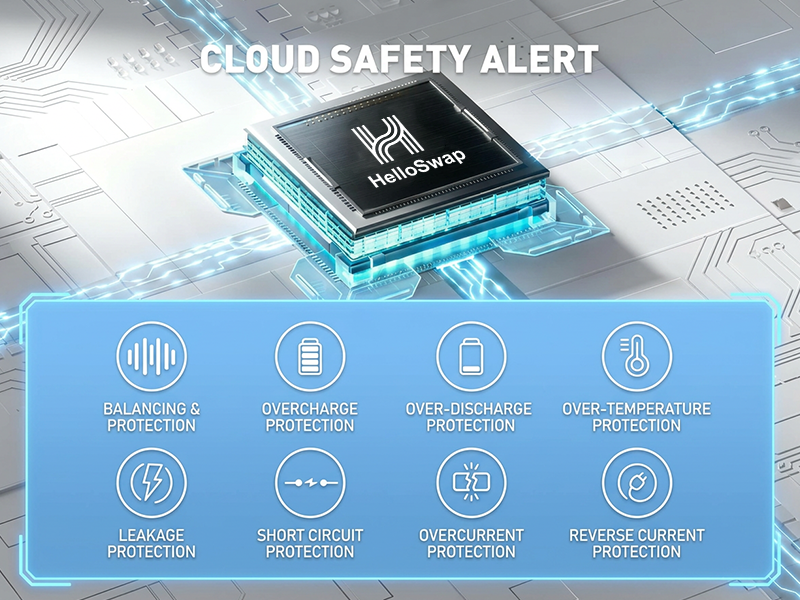
At the scale we operate, this intelligence isn't a feature list—it's an operational necessity. A delivery platform running 1,000 bikes cannot afford unpredictable downtime or a thermal incident in a residential building. The intelligence layer is what gives operators the confidence to depend on swap infrastructure rather than treat it as a supplement to home charging.
Battery swapping won't replace every form of EV charging for two-wheelers. Riders who own their bikes and charge at home overnight are not the primary use case. The case for battery swapping is strongest where utilization is high, where downtime is expensive, and where waiting hours for a charge is simply not compatible with the vehicle's operational demands.
That describes most of the high-growth two-wheeler markets in the world right now: delivery fleets, ride-hailing operators, shared mobility platforms, and commercial riders across Asia, Africa, and Southeast Asia. As electric two-wheelers displace gasoline bikes in these segments, the energy model that makes operational sense is the one that keeps vehicles moving.
The infrastructure is being built. The standards are being written. The intelligence layer is mature enough to run on. For operators and cities evaluating how to power the next generation of electric two-wheeler fleets, the foundational question is no longer whether swap networks work, but how to build them well for a specific market and use case.
Reach out to HelloSwap to discuss what deployment looks like in your market.
Contact Us
hellopowerglobal@hellobike.com
Location
2F, Building 1, No.898 XiuWen Road, MinHang District, Shanghai, China
Copyright © 2024 福建宁德惠智无限科技有限公司 All Rights Reserved. 闽ICP备2023025900号-3.


