
Battery Swapping System and Techniques for Electric Two- and Three-Wheelers
2026-04-17
Battery swapping has a reputation for being capital-intensive. That reputation is not wrong, but it just tells half the story. The operators who have built profitable networks did not do it by spending less. They did it by understanding exactly what they were building: not a hardware business, but a service business with hardware as its foundation.
In this guide, we draw on operational data and partner experience from the HelloPower & HelloSwap network to break down the real economics—what the revenue looks like, where the costs actually sit, and what operators have achieved in practice.
There is one distinction that separates operators who scale from those who stall: selling batteries is a transaction. Providing energy access is a service.
For delivery riders and gig-economy workers, electricity is not a commodity but a production input. A rider who runs out of charge mid-shift does not miss a deadline; they lose income. That urgency is what makes a well-run swapping network so commercially powerful. Riders do not need convincing to swap. They need a network reliable enough to build their workday around.
When operators internalize this, the entire business logic changes. Revenue stops being tied to one-time hardware sales and starts compounding through subscriptions, per-swap fees, and the loyalty of riders who come back every single day. The competitive advantage is not the product—it is the habit.
"The industry competition is no longer about who sells more products. It is about who can deliver the most reliable, safe energy service while keeping risk and after-sales costs under control."
— HelloPower Partner Conference, Xiamen, January 2026

Sustainable profitability in battery swapping comes from layering income streams rather than relying on any single one.
Riders access batteries through monthly subscription plans or pay-per-swap arrangements. This is the most predictable income line—high-frequency and relatively stable, directly proportional to how well the network is placed and maintained. Subscriptions dominate the market because operators and riders both prefer predictable costs over transactional uncertainty. A well-sited 10-slot cabinet in a commercial delivery corridor can reliably process 30–60 swaps per day once the rider base is established.
Delivery platforms and logistics operators need guaranteed uptime, consolidated billing, and SLA-backed availability. Landing a commercial fleet as an anchor client de-risks a station's daily utilization from day one—and fleet-focused stations break even approximately 8 months faster than mixed-use locations.
Riders who visit a swap cabinet every day build real trust with the operator. That trust extends naturally to battery purchases, vehicle upgrades, maintenance services, and rentals—all higher-margin than the swap itself, and all requiring zero additional rider acquisition cost.
We describe this as "swap as the high-frequency entry point, vehicle services as the revenue multiplier." At our Xiamen partner conference, our smart battery retail division was positioned precisely as this downstream layer—battery sales, agency partnerships, and end-of-life battery buyback all flowing from the same rider relationships the swap network builds daily.
These are not projections. These are results shared by our partners in China at the HelloPower conference in Xiamen, January 2026.
One Beijing-based distributor grew monthly revenue from a few tens of thousands CNY at launch to over one million, and expanded from a single city to multi-city operations. Not driven by timing or one-off product success, the growth came from a replicable system: strategic cabinet placement, methodical subscription building, and consistent execution.
The key factor they highlighted was response speed—when questions came up about placement, pricing, or rider retention, the platform answered fast and specifically.
A Shenzhen technology company in our network reported two consecutive years of revenue doubling year-on-year, with headcount growing fivefold over the same period.
Their explanation: a clear management framework—tracking net growth rates, repurchase rates, and active user counts as operational KPIs—replaced guesswork with a repeatable, measurable growth system.
One of our founding partners has been in the network for seven years. They started with a team of four. Today, they operate across more than 20 cities with over 100 staff.
That trajectory is what the model produces when operators treat a swapping network as infrastructure that compounds over time—not inventory that turns over once.
A Guizhou-based delivery services company shared a clear strategic position: consolidate market share steadily to build a durable foundation for long-term growth.
Their approach reflects what consistently works across our partner base—prioritizing rider retention and service quality over short-term discounting.
Revenue potential means nothing without an honest view of the cost structure. There are four areas every operator should model clearly before deploying.
A HelloSwap 10-slot smart swap cabinet typically costs USD 1,400–2,000. 48–72 V HelloPower battery packs range from USD 240–680. A practical entry deployment—one cabinet, 20 batteries, 15–25 compatible vehicles—generally requires USD 10,000–20,000 before vehicles.
This is the single most important ongoing cost variable. Packs in unmanaged charging environments degrade quickly and need replacing often. In our network, batteries maintain roughly 80% capacity after 1,200+ full cycles. Our battery health prediction algorithm extends average pack lifespan by approximately 20% through intelligent charge management—every additional month of battery life is a direct reduction in the most significant recurring cost.
A thermal event can ground a station, trigger liability, and erase months of rider trust. Our architecture addresses this at two levels: local BMS provides real-time hardware-level protection, while cloud management analyzes usage patterns across the network to flag abnormal usage patterns before they develop into failures. Our closed-loop system assigns each battery a unique digital identity, enabling full lifecycle traceability and ensuring retired packs are processed by certified handlers—protecting operators from regulatory exposure as industry standards tighten.
Beyond hardware, operators should factor in site leasing costs, electricity pricing variability, and ongoing maintenance or field service requirements, which vary significantly depending on local real estate and energy costs. Cloud-based network management reduces the need for on-site intervention, keeping per-swap operating costs low as the network grows.
Depending on utilization and local cost structures, well-performing battery swap stations with stable daily utilization typically reach payback within 18–30 months, with fleet-backed locations trending toward the lower end of that range.
We offer three partnership structures to match different goals and starting points:
Brand franchise (direct or affiliate): Operate under the HelloSwap brand with full supply chain access, training, and platform support — the fastest path to market for operators new to this category
Speed-Swap Alliance (white-label): Build your own brand using our cabinets, batteries, and SaaS infrastructure as the back end — suited for operators who want regional brand ownership with proven technology underneath
Fleet integration: For delivery companies and logistics operators who want to bring a managed battery pool directly into their own operations
Across all three, the underlying economics work the same way: swap revenue as the stable base, adjacent services compounding on top of it. The choice comes down primarily to how much brand control and operational independence you want—assuming the model is executed with sufficient density and operational discipline.
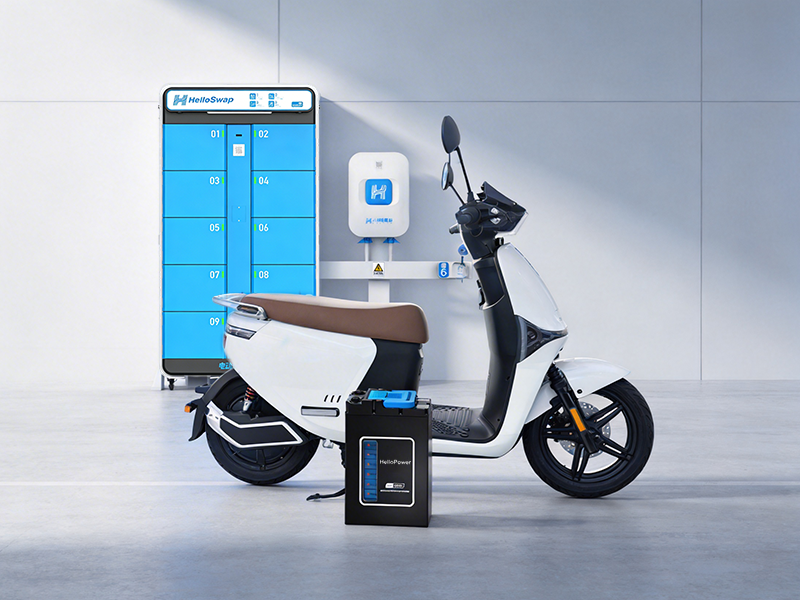
HelloPower is backed by Hello Inc., Ant Group, and CATL, giving us platform scale, financial infrastructure, and battery technology to support partners at every stage of growth. Across the HelloPower ecosystem, the network has scaled to 80,000+ swap cabinets and 5 million batteries deployed, supporting hundreds of millions of registered users across affiliated mobility platforms in 500+ cities. That operational depth translates into repeatable deployment playbooks, refined through large-scale, real-world usage rather than pilot-stage experimentation.
Globally, the battery swapping market is projected to grow from USD 1.46 billion in 2025 to USD 22.72 billion by 2035. The markets showing the fastest early traction—dense urban areas with high concentrations of delivery riders, gig workers, and commercial fleets—exist across every major region. In most markets, station density is still low, prime locations are available, and rider loyalty has not yet consolidated around any dominant network. Operators who enter now inherit our years of engineering and real-world operational experience—rather than having to acquire it through expensive trial and error.
Ready to evaluate battery swapping for your city, fleet, or investment? We can model expected utilization, cost structure, and payback timelines based on real network data. Reach out via the contact form below or visit our contact page.
Contact Us
hellopowerglobal@hellobike.com
Location
2F, Building 1, No.898 XiuWen Road, MinHang District, Shanghai, China
Copyright © 2024 福建宁德惠智无限科技有限公司 All Rights Reserved. 闽ICP备2023025900号-3.


