
Is Battery Swapping Actually Profitable? A Practical Guide for Operators and Investors
2026-04-22
Shared micromobility has matured well beyond the kick-scooter era. The next frontier—shared seated e-mopeds—brings a fundamentally harder operational problem: how do you keep a fleet of heavier, faster, higher-capacity vehicles running around the clock without drowning in charging logistics? Battery swapping isn't a feature add-on for this segment. It's the operational backbone that makes the entire model viable.
When most people picture shared micromobility, they imagine a dockless kick-scooter on a city sidewalk. But a different category has been quietly scaling across Asia, India, and Europe: shared seated, step-through e-mopeds—vehicles with a step-through frame, a flat floorboard, and an upright riding position designed for urban trips rather than athletic cycling. Providers like Felyx and Check in the Netherlands and Germany, Cooltra across Southern Europe, and Yulu in India have been deploying thousands of these vehicles in dense urban corridors.
These aren't novelties. Seated e-mopeds fill a mobility gap that stand-up scooters and e-bikes simply can't: longer urban trips (5–15 km), all-weather stability, and the carrying capacity needed by commuters and daily riders alike. Their rider demographics are also distinct—fewer tourists, more daily commuters and gig workers—which means vehicle uptime is not optional; it's the entire value proposition.
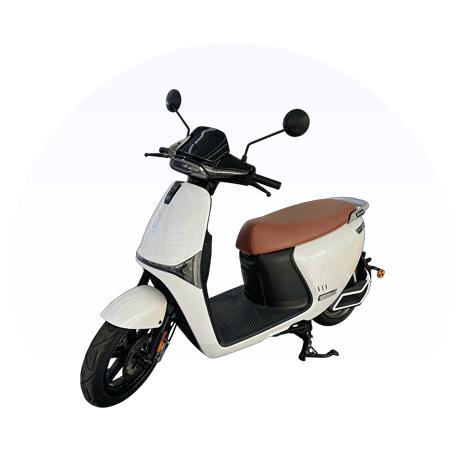
This is precisely why this segment faces a charging crisis that kick-scooter fleets never had to solve at the same scale.
A typical shared e-moped carries a battery in the 60V–72V range, weighing between 10 and 22 kg. Plug-in charging takes 4–6 hours. For a fleet operator, that math is brutal:
A vehicle charging for 5 hours serves zero rides during that window
Dispatching vans to collect, charge, and redeploy vehicles burns fuel, labor, and time
Street-based charging infrastructure (cables, locks, weatherproofing) is expensive and theft-prone
Batteries charged in uncontrolled environments—a rider's apartment, a sidewalk outlet—introduce serious fire risk
Early shared mobility operators dealt with this via distributed gig-economy chargers who collected scooters overnight, charged them at home, and redeployed them in the morning. The model has since declined industry-wide: the logistics were expensive, vehicle availability suffered during overnight charging windows, and home charging introduced fire risks that regulators in multiple cities moved to restrict. Seated e-mopeds, with their heavier frames and larger batteries, make the collection-and-charge model even less practical.
Battery swapping cuts through all of this. A depleted battery is replaced with a fully charged one within minutes, so the vehicle never leaves service. The battery is managed in a controlled cabinet environment, and the operator's software tracks every asset in real time.
In shared e-moped fleets, battery swapping is deployed in two distinct ways, and understanding the difference matters for operators evaluating the model.
Operator-Performed (B2B) Swapping is now standard among many shared micromobility providers. A dedicated operations team monitors the fleet's state-of-charge data and proactively swaps batteries before vehicles hit low levels. Riders simply find a moped on the map with a healthy battery and ride away, never needing to think about energy at all. This model prioritizes a seamless user experience and suits casual urban riders.
Station-Based (B2C) Swapping takes a different approach: a network of smart swap cabinets is distributed across the city, and riders pull up to any station, return their depleted battery, and collect a fully charged one. For operators running subscription-based shared fleets—where riders use the same vehicle across multiple sessions—this model distributes the battery replenishment workload across the city rather than relying solely on a field operations team. Riders aren't inconvenienced; a quick station stop is far less disruptive than hunting across the map for a vehicle with sufficient charge.
Both models depend on the same underlying infrastructure: dedicated smart battery swapping stations, a software platform that tracks battery health and location, and a battery form factor standardized across the fleet vehicles.
The smart swapping cabinet is the physical nerve center of the entire operation. Modern cabinets like those from HelloPower & HelloSwap are far from passive storage units—they actively manage the batteries inside them.
A well-engineered cabinet operates continuously across environmental extremes and incorporates real-time temperature and smoke monitoring, fire suppression systems, dual-lock mechanical security, and IP-rated weatherproofing for semi-outdoor and outdoor deployment. Each slot charges independently, with intelligent current control per battery to maximize cycle life.
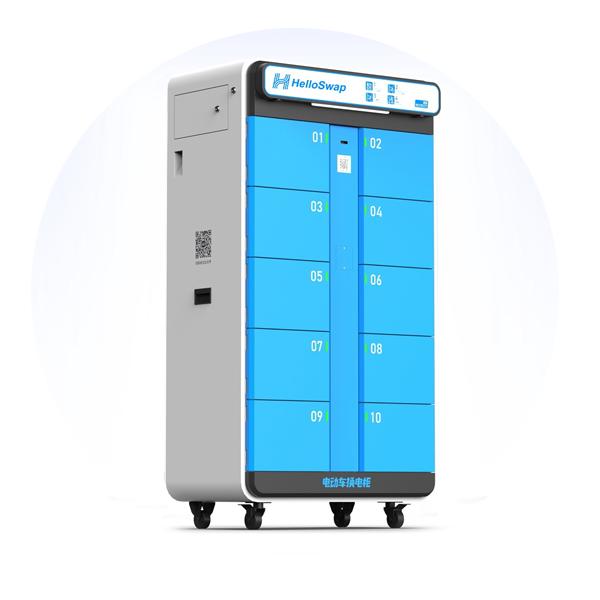
On the software side, a platform layer (SaaS + PaaS) continuously aggregates cabinet status, battery state-of-charge, and vehicle location data. This feeds an intelligent dispatch system that tells operators exactly which cabinets need restocking, which batteries are degrading, and where to position inventory ahead of demand peaks. For a shared mobility operator managing hundreds of vehicles across a city, this is the difference between a profitable operation and a logistical nightmare.
The business case for battery swapping in shared e-moped fleets isn't theoretical. The operational improvements are measurable:
Fleet utilization: Vehicles running 18–22 hours per day instead of 12–14 hours, because charging downtime is eliminated
Operating cost reduction: Studies on swappable-battery micromobility fleets show 50–80% lower operational costs compared to collection-and-charge models, primarily through reduced labor and logistics
Battery longevity: Controlled charging in temperature-managed cabinets extends cycle life significantly; in well-managed swap networks, high-quality lithium packs with smart BMS can deliver up to 2,000+ full charge cycles before reaching end-of-life capacity
Fire risk reduction: Centralized charging in monitored cabinets eliminates the distributed residential charging risk that has caused fires in multiple cities and prompted regulatory crackdowns on gig-charged fleets
For a fleet of a few hundred e-mopeds, the difference in daily revenue from even a 6-hour increase in per-vehicle uptime—at a modest revenue-per-vehicle-hour figure—compounds quickly into a margin-defining advantage.
A key challenge in shared e-moped battery swapping is standardization. Different vehicle brands often use different battery dimensions and communication protocols, so an operator is effectively choosing a battery platform and compatible vehicles at the same time.
In practice, leading swapping providers solve this with OEM partnerships and standardized pack interfaces rather than leaving operators to manage it alone. Vehicle manufacturers design around defined swappable battery specs, and the swap operator ensures those packs integrate cleanly with cabinets, software, and safety systems.
For fleet operators and cities, the key is choosing a partner that already controls the full stack—batteries, cabinets, vehicle integration, and the data layer—so standardization becomes a built-in advantage rather than a technical risk.
HelloPower (HelloSwap) was built precisely to be that partner. Co-founded by Hello Inc., Ant Group, and CATL, HelloPower combines operator-grade field experience with best-in-class battery technology and digital infrastructure.
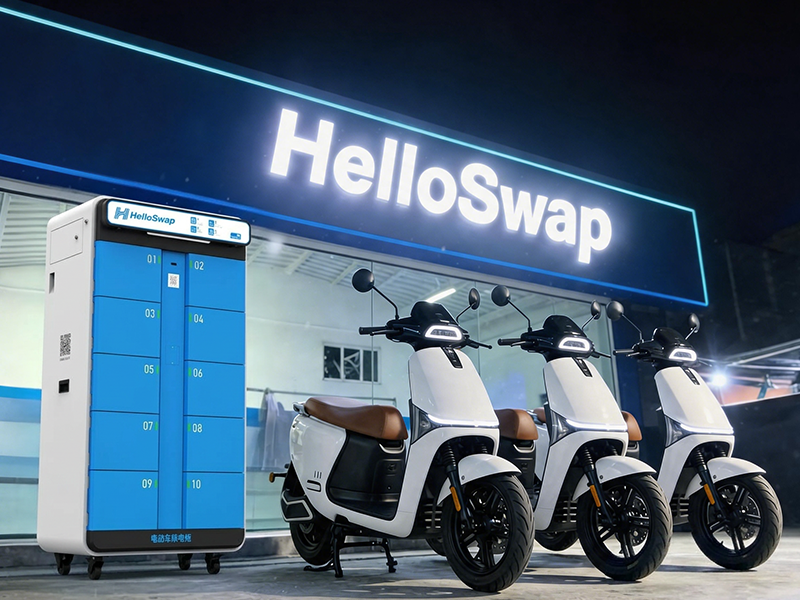
The product stack covers everything a shared mobility operator needs to launch and scale: intelligent swap cabinets, multi-spec batteries, a compatible e-moped lineup, a rider-facing app, an operator-facing fleet management platform, and a full SaaS/PaaS data layer. HelloPower doesn't just supply hardware—the team provides end-to-end operational support, from data-driven site selection to on-the-ground launch support and ongoing performance optimization.
With over 80,000 battery-swapping cabinets deployed, 5 million batteries under management, and operations spanning 500+ cities, HelloPower brings a scale of real-world operational knowledge that no new market entrant could replicate from scratch. That knowledge—built from over 1 million daily swapping events—is precisely what gives new operators the confidence to move fast and scale sustainably.
If you're an urban mobility operator, a fleet services company, or a city looking to introduce shared seated e-mopeds, the infrastructure question is the first one to answer—and battery swapping is the answer the industry has converged on. HelloPower's end-to-end solution gives you the hardware, software, and operational playbook to launch faster, run leaner, and grow sustainably.
Contact HelloPower to discuss your market, fleet size, and goals. The team will assess your project and build a deployment roadmap tailored to your specific city and use case.
Contact Us
hellopowerglobal@hellobike.com
Location
2F, Building 1, No.898 XiuWen Road, MinHang District, Shanghai, China
Copyright © 2024 福建宁德惠智无限科技有限公司 All Rights Reserved. 闽ICP备2023025900号-3.


