
Is Battery Swapping Actually Profitable? A Practical Guide for Operators and Investors
2026-04-22
When you look at a lithium-ion battery electric scooter, motorcycle, or three-wheeler, you only see a "battery box." Inside that box, however, the choice between cylindrical, prismatic, and pouch cells quietly decides vehicle dynamics, safety margins, and the true cost per kilometer over thousands of cycles.
For a high-frequency swapping network like HelloPower & HelloSwap, cell format is not a lab detail—it shapes how durable each swappable pack is, how safe the charging swap cabinets remain over time, and how reliably millions of riders can stay on the road every day. Understanding these three cell types helps OEMs, fleet operators, and even riders judge whether a battery system really fits their needs.
Two- and three-wheelers operate in tough conditions: constant vibration, speed bumps and potholes, tight mounting spaces, and, in swappable systems, thousands of insertions and removals throughout the pack's life. At the same time, operators want:
maximum usable range per swap,
predictable safety under all conditions,
long cycle life in high-frequency operation, and
packs that fit standardized, easy-to-handle modules and cabinets.
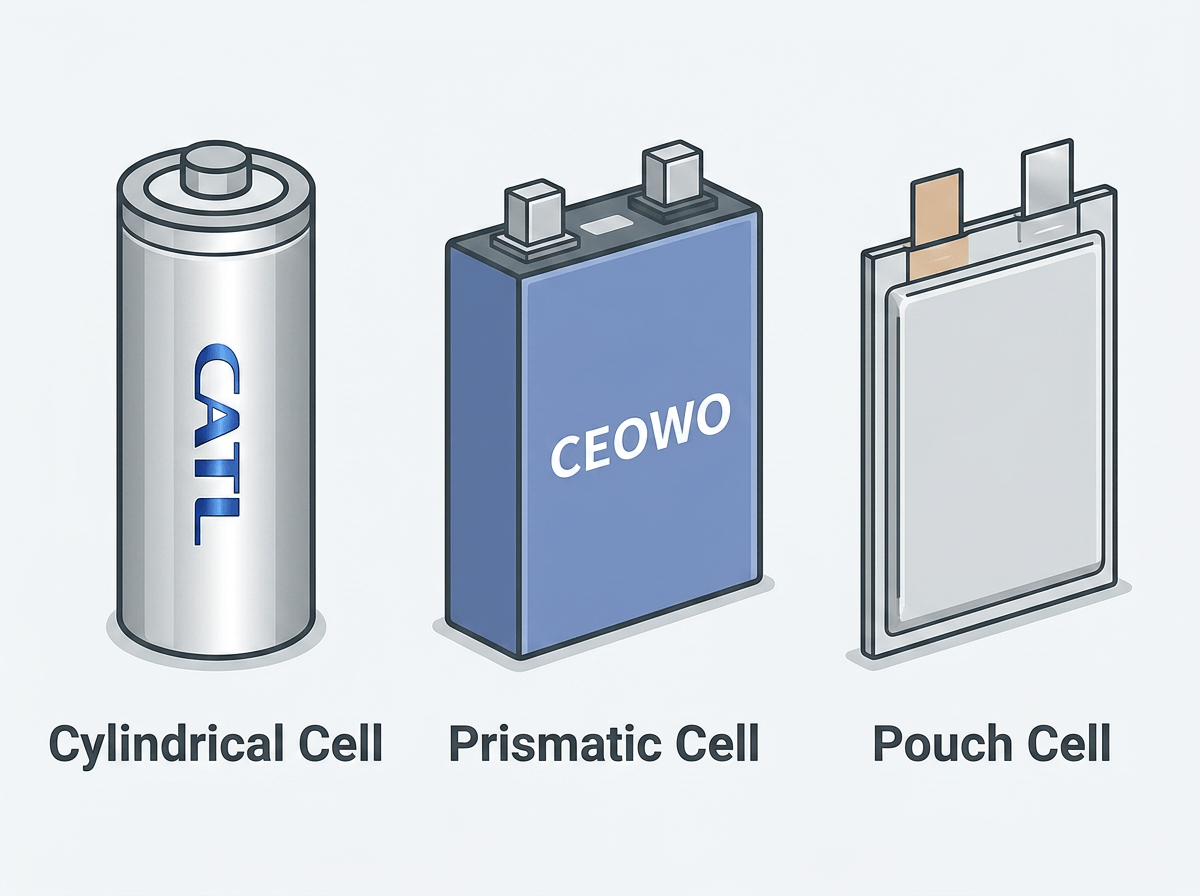
Cell geometry is one of the main levers engineers use to balance these demands. Cylindrical lithium-ion cells offer strong mechanical robustness and straightforward cooling; prismatic lithium-ion cells maximize the use of rectangular volume; lithium-ion pouch cells can deliver very high energy efficiency at the pack level when combined with careful structural protection.
None is universally "best"—each can be optimal for specific vehicle classes and duty cycles.
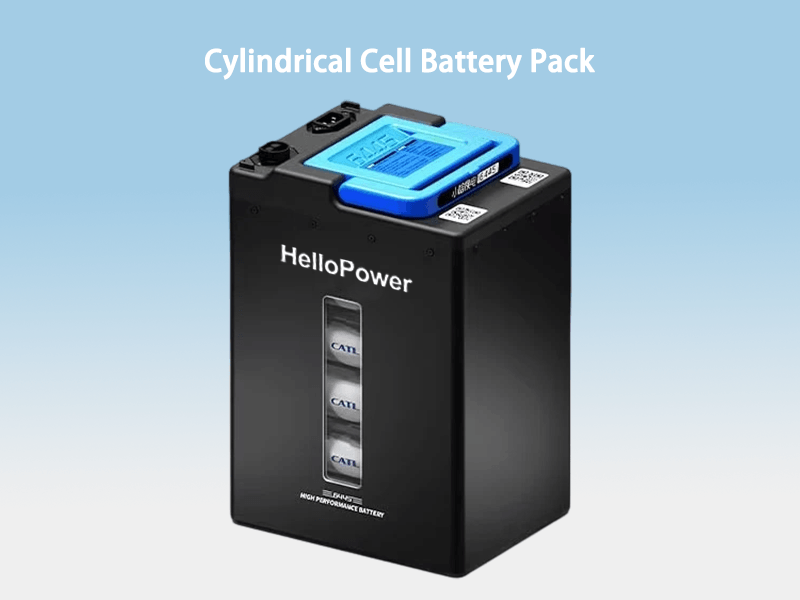
Lithium-ion cylindrical cells are the traditional cylindrical format: smaller 18650 and 21700 cells and newer large-format 46xx variants. Inside, electrode layers are rolled into a jelly-roll and sealed in a metal can, creating a robust building block for light electric vehicles.
Mechanical robustness
The metal can provides inherent structural containment and pressure resistance, helping each cell withstand vibration, accidental drops, and the repeated mechanical stress of daily swapping. This makes cylindrical LFP or NMC packs strong candidates for delivery scooters and shared fleets that run for long hours every day.
Thermal behavior
Cylindrical cells are often easier to cool in simpler two-wheeler pack designs because their geometry leaves natural spacing between cells, which can be used for airflow or coolant channels. With well-placed paths, this helps manage heat during fast charging or high-power acceleration, although prismatic and pouch packs can achieve comparable thermal performance with engineered cooling plates and interfaces.
Manufacturing maturity
Cylindrical formats benefit from decades of mass production. High automation and large volumes in EVs and tools deliver consistent quality and competitive cost per kWh.
From a safety viewpoint, many cylindrical cells integrate pressure-relief mechanisms to manage gas venting during extreme events. Different formats also behave differently in how failures propagate between cells: smaller cylindrical cells can help limit propagation at the pack level, while larger prismatic and pouch cells require careful spacing, barriers, or thermal strategies to prevent cell-to-cell escalation. Even so, no format is inherently "safe" without strong BMS design, fusing, and mechanical protection.
Because many small cells are combined in one pack, the number of welds and interconnections can be high, making welding quality and vibration management critical, especially in three-wheelers and cargo platforms. Cylindrical packs can also be less space-efficient, since the interstitial gaps between round cells do not store energy.
For battery swapping companies, cylindrical lithium-ion cells are a natural fit for rugged, high-cycle swappable packs where abuse resistance and predictable thermal behavior under frequent use are as important as energy density.
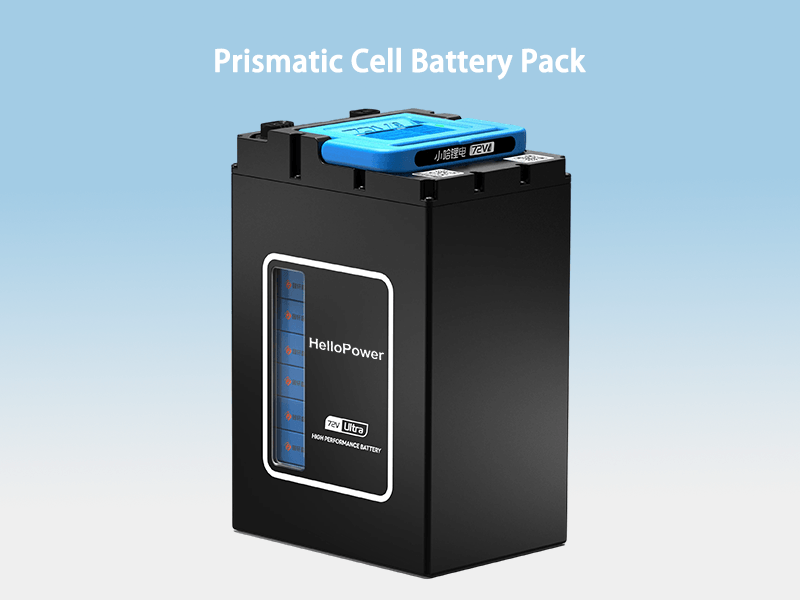
Prismatic lithium-ion cells package electrode layers into rigid rectangular cans, typically aluminum or steel. For many electric scooters and three-wheelers, this geometry matches the battery bay extremely well, allowing dense rectangular packing within constrained enclosures under the seat or floorboard.
Space and packing efficiency
Prismatic cells can be stacked closely with minimal unused volume, making them strong candidates for box-shaped scooter bays and standardized swap modules. In the same outer dimensions, a prismatic-based pack can often hold more energy than a cylindrical pack that loses some volume to gaps between cells.
Fewer cells, fewer connections
Each prismatic unit typically has higher capacity than a single cylindrical cell, so a pack can reach its energy and voltage targets with fewer parallel groups and interconnects. Fewer welds and joints mean fewer potential failure points under the vibration and mechanical shocks common in urban two- and three-wheeler duty.
Structural integration and modern architectures
The rigid casing contributes to pack stiffness and can be integrated into the structure of the battery module or box. Emerging designs such as cell-to-pack (CTP) architectures further improve space utilization, especially with prismatic formats that can be integrated more directly into the module or frame to cut module overhead and increase usable energy per liter.
Lithium-ion prismatic packs can concentrate heat if cells are tightly stacked without adequate thermal paths, so designers rely on cooling plates, conductive interfaces, or end cooling strategies to keep temperatures within a safe, uniform range. They also require consistent mechanical compression via end plates or tension rods; loss of compression over time can accelerate swelling and reduce the expected cycle life.
Cost-wise, there is no longer a simple rule such as "prismatic is always more expensive." In high-volume production, both prismatic and cylindrical cells can achieve very competitive cost per kWh, especially in major Asian two-wheeler markets, with final pricing driven more by chemistry, supplier scale, and local logistics than by cell shape alone.
For battery swapping, prismatic LFP or NMC cells are attractive in larger scooters and three-wheelers where maximizing energy in a fixed box is crucial and where fewer interconnections translate into better long-term reliability in a swap ecosystem.
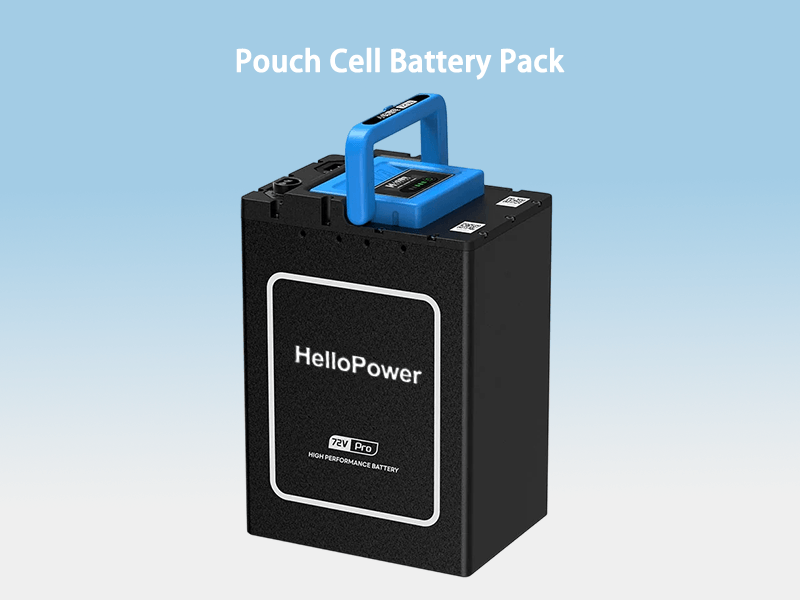
Lithium-ion pouch cells use a flexible aluminum-plastic laminate instead of a rigid metal housing, minimizing inactive casing material. This allows engineers to tailor length, width, and thickness to match very specific battery footprints in scooters, motorcycles, or standardized swap modules.
Energy and weight efficiency
Pouch cells can achieve very high energy density, particularly at the pack level, because very little mass and volume is consumed by metal cans or thick housings. With appropriate packing and compression frames, more of the available space and weight budget can be devoted to active material.
Flexible form factor
Pouch cells can be customized to fit thin floorboard packs, narrow frames, or proprietary module shapes while still remaining compatible with a given cabinet slot or mounting standard. This flexibility is valuable when different markets or OEM partners require slightly different outer dimensions without redesigning the entire platform.
Large, coolable surfaces
The wide faces of pouch cells provide good contact area for cooling plates, helping maintain stable temperatures at the higher C-rates needed for fast swapping and rapid acceleration when compression and interfaces are properly designed.
Pouch cells release internal pressure through swelling of the laminate rather than building up high pressure inside a rigid metal can. This changes how pressure is released compared to cylindrical or prismatic formats, but it also means pouch cells rely heavily on the outer module housing and internal supports for mechanical protection and gas management.
Here, chemistry plays a decisive role:
LFP pouch cells combine an inherently thermally stable chemistry with a flexible package. In abuse scenarios, they are more likely to vent gas and swell than to maintain high internal pressure, but they still require strong casings, compression frames, and careful pack design to protect against puncture, deformation, and vibration.
NMC pouch cells can deliver very high specific energy and power, yet if overcharged or punctured, they may still enter aggressive thermal runaway, which is why high-performance packs based on NMC pouch cells rely on tight BMS controls, robust barriers, and conservative operating windows.
As with other formats, thermal propagation must be managed at the pack level. Larger pouch and prismatic cells carry more energy per unit, so designers use spacing, thermal interfaces, and structural barriers to slow or prevent escalation from one failing cell to neighboring cells.
In a swapping network, any pouch-based solution must be complemented by robust mechanical module design, precise manufacturing, and ongoing monitoring of cell behavior to manage swelling and keep module dimensions stable for smooth cabinet insertion over the pack's life.
Most modern two- and three-wheeler packs use either LFP (Lithium Iron Phosphate/LiFePO₄) or NMC/NCM (Nickel Manganese Cobalt/Nickel Cobalt Manganese) chemistries. Each brings a different balance of performance, safety, and cost:
LFP:
Excellent thermal stability and low tendency to ignite under abuse, which is particularly important for densely packed urban fleets.
Long cycle life—often 2,000+ cycles with appropriate design—making it ideal for high-frequency swapping and daily delivery or sharing operations.
Lower energy density and higher weight per kWh, which pushes pack designers toward space-efficient layouts and careful module integration.
NMC/NCM:
Higher energy density and strong performance at higher speeds and in cooler climates, ideal for premium or long-range motorcycles.
Fewer cycles than LFP under similar conditions, but very attractive where lightweight packs and extended range per swap are top priorities.
In real two- and three-wheeler projects, engineers rarely pick a chemistry or cell format in isolation; they combine them to serve distinct roles in the lineup. Common patterns include:
Cylindrical LFP cells deployed as a long-life, high-robustness option for workhorse fleets and shared vehicles, where thermal stability and cycle life are more important than shaving every kilogram from the pack.
Pouch LFP cells used when designers want to keep LFP’s safety and longevity but need more compact, lighter modules that fit strict envelope constraints, relying on strong housings and compression frames to protect the softer cells.
Prismatic NMC cells selected where higher energy density is needed in a rectangular bay—such as longer-range or higher-performance two- and three-wheelers—trading some cycle life for extended range and stronger acceleration within a fixed volume.
Across different options, the final behavior of the battery pack still depends on system-level decisions—BMS strategy, current limits, thermal management, mechanical design, and quality control—rather than chemistry or cell shape alone.
Backed by Hello Inc., Ant Group, and CATL, HelloPower & HelloSwap operates at a scale where cell format and pack architecture decisions are validated by real-world operating data, not just lab simulations. With millions of active batteries and tens of thousands of swapping cabinets, every design choice is measured against uptime, safety incidents, and cost per kilometer.
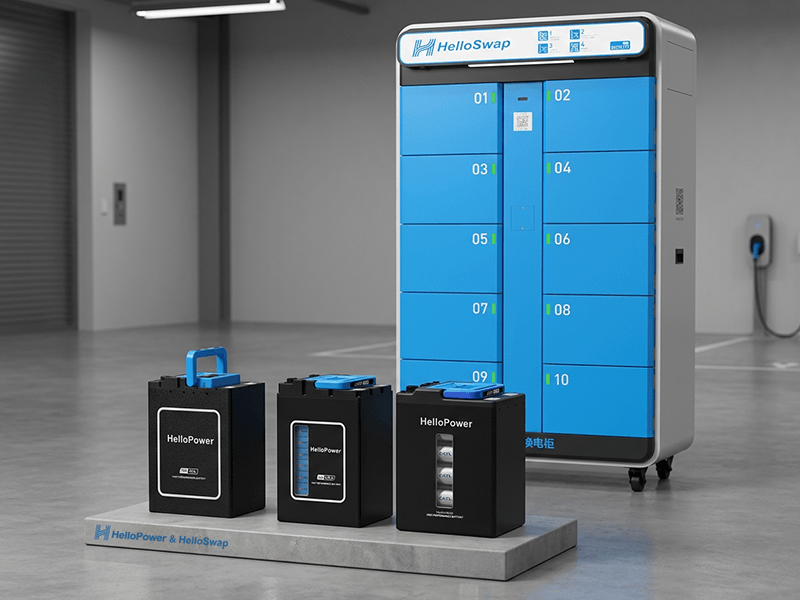
Several elements define how HelloPower turns cylindrical, prismatic, and pouch chemistries into concrete value for partners:
Tier-1 cells and chemistries matched to use case
HelloPower works with leading global manufacturers for both LFP and NCM cells, using cylindrical, prismatic, and pouch formats where each makes sense for a specific voltage platform and vehicle type. This ensures consistent performance and traceable quality for swappable packs.
Intelligent, connected swappable batteries
Every battery integrates an automotive-grade BMS, communication modules such as 4G and Bluetooth, and multiple hardware protections, including overcharge, over-discharge, overcurrent, short-circuit, and temperature protections. This connectivity allows real-time monitoring of pack health, load conditions, and environmental factors.
Cabinets as active safety and operations hubs
HelloSwap battery swap cabinets combine aerosol fire suppression, multi-point sensing for temperature and smoke, IP-rated enclosures, and 24/7 remote monitoring. Charging is moved from uncontrolled environments into supervised infrastructure, adding extra protection around whichever cell format and chemistry the module uses.
Design for swapping: connectors, vibration, and drop resistance
In swapping, the first weak point is often not the cell, but connectors, welds, and housings subjected to constant handling and vibration. HelloPower designs packs and cabinets to withstand repeated insertion, high-frequency vibration from two- and three-wheelers, and occasional drops, including robust busbar designs and carefully specified connectors.
Cloud-BMS and predictive maintenance
By aggregating data from millions of LFP and NCM cells across various formats, HelloPower's cloud platform can detect patterns like early swelling in pouch cells or abnormal resistance rise in specific batches. This enables preventive actions—such as pulling suspect modules from circulation—before riders experience noticeable degradation or safety concerns.
For OEMs and fleet operators, the question is no longer "Which cell type is the best on paper?" but "Which combination of chemistry, cell format, and swapping ecosystem will deliver the safest, most reliable, and most profitable operation for our riders and markets?" HelloPower's portfolio of cylindrical, prismatic, and pouch-based lithium-ion packs is built to answer that across daily delivery fleets, shared city scooters, and higher-performance commuter segments.
If you are exploring new electric two- or three-wheeler platforms or planning a battery swapping network, you can contact the HelloPower & HelloSwap team for a tailored cell-format and system design consultation based on real operating data from 500+ cities worldwide.
Contact Us
hellopowerglobal@hellobike.com
Location
2F, Building 1, No.898 XiuWen Road, MinHang District, Shanghai, China
Copyright © 2024 福建宁德惠智无限科技有限公司 All Rights Reserved. 闽ICP备2023025900号-3.


