
Guide to Building a Lithium-Ion E-Bike Battery Swap Station
2026-01-21
The electric two-wheeler market thrives on urban density. Food delivery riders often travel over 100 kilometers daily; express logistics handle millions of packages, and shared e-bike fleets serve thousands of commuters. High-frequency usage creates a critical infrastructure challenge: many batteries are continuously swapped within confined cabinets. Safety standards of battery swapping cabinets are therefore essential for operational continuity and public protection.
Industry incidents worldwide have led regulators to require rigorous certification for swap cabinets. Operators' key question is not "Are affordable units available?" but "Which suppliers offer proven designs, verified certifications, and real-time monitoring to prevent failures before they occur?"
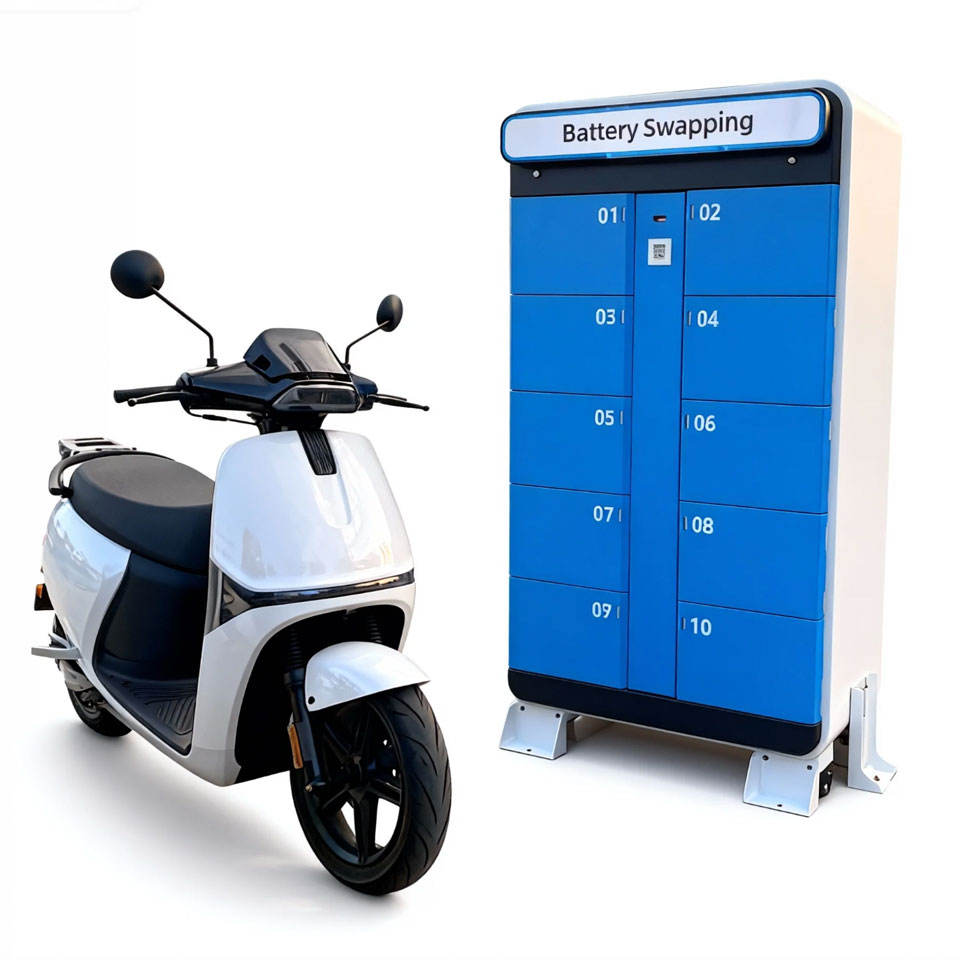
Thermal runaway occurs when a lithium-ion battery's internal temperature rises uncontrollably, triggering a self-sustaining chemical reaction. Localized hotspots can reach extremely high temperatures, releasing flammable gases. In battery swap cabinets, E2W batteries arrive with unknown charge histories, usage patterns, and thermal conditions, increasing the risk of unpredictable incidents without proper monitoring and screening systems.
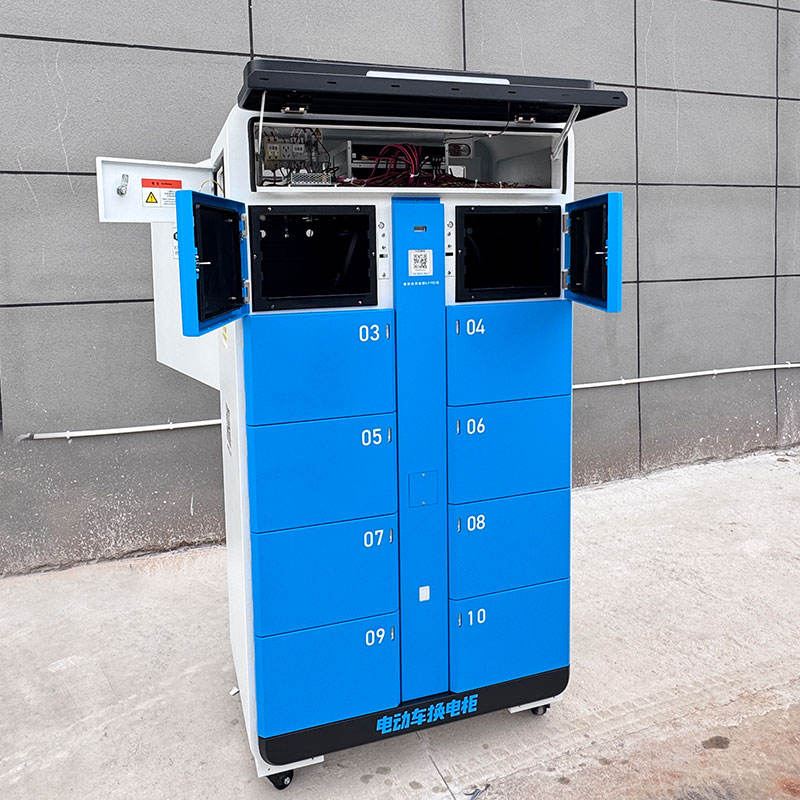
A single battery swap cabinet often stores 5–12 batteries in compact compartments. Without physical isolation, heat and gases from one battery's failure can spread to neighboring slots. Smoke and thermal energy may propagate horizontally, increasing the likelihood of secondary thermal events. Cabinets must contain such incidents to prevent cascading failures.
Battery swapping cabinets are typically deployed outdoors, exposed to sun, rain, dust, humidity, and temperature extremes. Coastal salt spray, northern freezing conditions, or tropical heat pose additional challenges. Users may mishandle batteries, forcing connectors or ignoring warnings. Cabinets must maintain internal stability under these real-world conditions.
Modern battery swap cabinets separate battery slots using metallic partitions and high-thermal-resistance materials, including fire-rated composites, insulation, and steel sub-enclosures. This containment delays heat transfer to adjacent compartments, providing critical time for detection and suppression systems. Hardware-level isolation ensures a baseline of safety, independent of electronics or power availability.
Temperature and smoke sensors monitor each compartment in real time. When abnormal conditions are detected, suppression activates only within the affected slot. Targeted deployment maximizes extinguishing efficiency, reduces unnecessary chemical use, and limits impact on unaffected batteries. Compartment-level activation ensures rapid containment of thermal events.
Dual-fan ventilation maintains safe internal temperatures, drawing in cool air while expelling heat-laden air. Thermostatic controls adjust fan operation based on real-time temperature. Continuous ventilation under high ambient conditions prevents heat accumulation and reduces reliance on suppression systems, protecting battery longevity while maintaining thermal safety margins.
HelloPower & HelloSwap's battery swap cabinets integrate hardware isolation, sensor-triggered suppression, and forced ventilation. Constant-temperature control ensures -20°C to 55°C operation, while compartment-level suppression contains thermal events effectively.
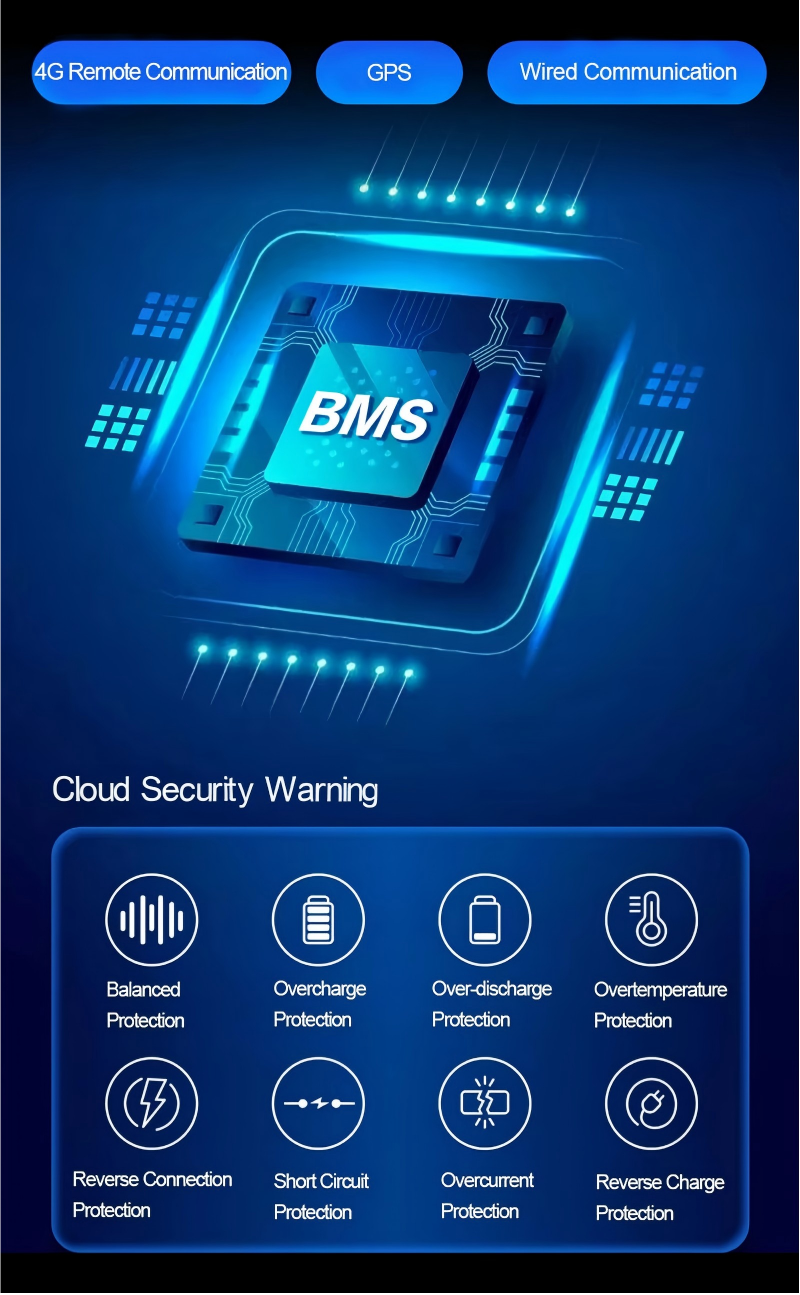
E2W batteries from multiple sources have inconsistent maintenance histories. Riders swap packs immediately after intense use, and charging cycles vary widely. This requires BMS systems capable of evaluating state-of-health, state-of-charge, voltage, and temperature before redistributing packs, ensuring that high-risk batteries do not enter operational circulation.
Each battery contains an integrated BMS, while the battery swap cabinet operates with independent management logic. The cabinet verifies battery-reported health via CAN bus communication and cross-checks measurements. If discrepancies occur, the battery remains locked and is quarantined. Redundant BMS architecture reduces single points of failure and prevents compromised batteries from entering service.
HelloPower & HelloSwap's battery swap solutions operate intelligent BMS to monitor battery voltage, temperature, and cycle counts, with cloud-based diagnostics flagging degrading batteries. Pre-swap verification quarantines anomalous packs for safe operations without manual intervention across extensive swapping networks.
Battery swapping cabinets connect via 4G/Wi-Fi to cloud platforms tracking temperature, humidity, smoke sensors, electrical parameters, and suppression events. Machine learning algorithms identify abnormal patterns across thousands of cabinets, flagging elevated thermal risks before failures occur. This predictive intelligence supports proactive maintenance and reduces reliance on reactive inspections.
Continuous data analysis enables operators to target preventive interventions rather than reacting to isolated failures. Abnormal suppression activations trigger automated diagnostics to determine whether maintenance or deeper investigation is required. Network-wide monitoring ensures safer large-scale operations with minimal manual oversight.
HelloPower & HelloSwap's smart battery swap stations combine IoT monitoring with predictive analytics. Cloud-based surveillance identifies risks before failures occur, enabling proactive maintenance, reducing system-wide failure probability, and minimizing reliance on reactive measures or manual inspections.
Battery swapping cabinet standards are evolving rapidly. In China, CQC certification is a key government-recognized benchmark. Internationally, UL 9540, IEC 62933, and NFPA 855 are increasingly referenced for energy storage and swapping infrastructure, including battery swap cabinets for electric two-wheelers. These standards cover enclosure integrity, thermal propagation, electrical safety, and suppression effectiveness.
Regional priorities differ: Southeast Asia emphasizes high-temperature and high-humidity performance; Europe focuses on traceability and liability; North America references UL listings and validated thermal testing. Battery swap cabinets intended for global markets should use modular architectures, corrosion-resistant materials, and compliance documentation supporting multi-region certification.
Selecting battery swapping cabinets with mature compliance credentials reduces retrofit costs, simplifies permitting, and facilitates insurance underwriting. Early integration of international standard requirements into design accelerates certification timelines and enables rapid market entry and adoption across regions.
HelloPower & HelloSwap is the first company in China to receive CQC certification for two-wheeler battery swap cabinets (May 2021), with ongoing international compliance expansion (e.g., Thailand NBTC certification) for smooth, efficient global deployment and market adaptation.
Safety standards define sustainable two-wheeler battery swap infrastructure operators. Effective battery swapping cabinet design requires proven fire protection, intelligent BMS, real-time monitoring, and verified compliance. Choosing qualified suppliers ensures operational reliability, regulatory alignment, and long-term network scalability.
HelloPower & HelloSwap combines CATL's battery expertise, Ant Group's digital infrastructure, and Hello Inc.'s operational experience to deliver battery swap cabinets engineered for rough conditions and regulatory compliance across multiple markets. From hardware selection to system deployment, the platform supports end-to-end safety assurance.
Contact HelloPower & HelloSwap today for a personalized safety assessment and deployment consultation to secure your competitive advantage with proven, certified battery swap solutions.
Thermal runaway is the uncontrolled rise in battery temperature that leads to self-sustaining chemical reactions. In multi-battery cabinets, one failing cell can ignite neighbors without compartment isolation.
BMS continuously monitors battery voltage, current, and temperature, isolating batteries exceeding safe thresholds. It detects degradation patterns, quarantining risky packs before they enter operation.
Aerosol suppression is compact, non-conductive, leaves no residue, instant activation. Water offers superior cooling but risks electrical shorting and steam explosions if contacting molten lithium.
Industry practices typically include monthly visual inspections and quarterly functional testing. HelloPower & HelloSwap's 24/7 AI monitoring flags anomalies in real time, reducing reliance on manual inspections.
Contact Us
hellopowerglobal@hellobike.com
Location
2F, Building 1, No.898 XiuWen Road, MinHang District, Shanghai, China
Copyright © 2024 福建宁德惠智无限科技有限公司 All Rights Reserved. 闽ICP备2023025900号-3.


